When your child is already in the middle of an ADHD meltdown, it’s very easy to forget every parenting strategy you’ve ever learned.
Your child is yelling.
Maybe they’re crying.
They’re refusing everything you suggest.
You’re trying to figure out what started this.
A sibling is watching.
You’re getting frustrated yourself.
And somewhere in the middle of all that chaos, you’re supposed to remain calm and somehow know exactly what to do.
I’ve learned that trying harder to reason with a child during an ADHD meltdown can sometimes make the situation worse rather than better.
That’s because my goal during the peak of a meltdown isn’t really to teach.
It isn’t to win the argument.
It isn’t even necessarily to solve whatever originally caused the meltdown.
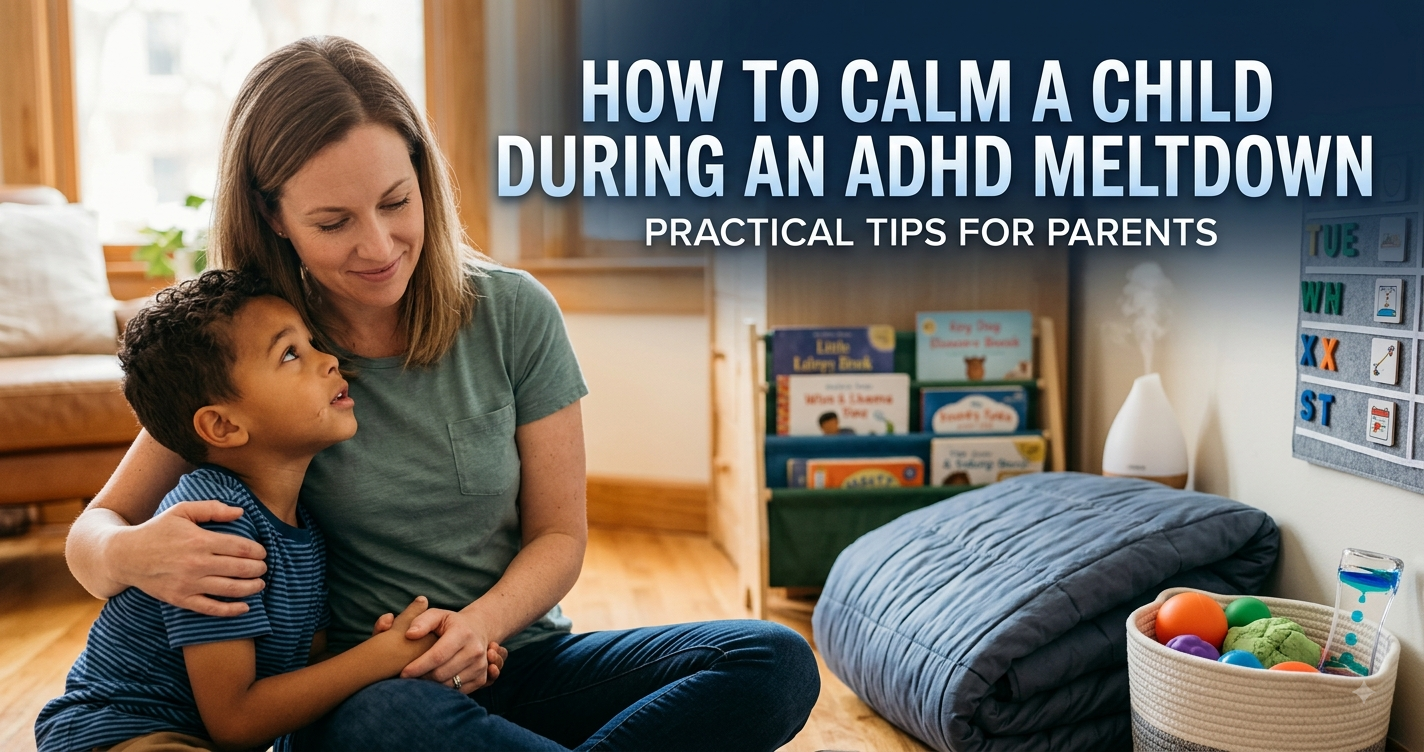
My first job is much simpler:
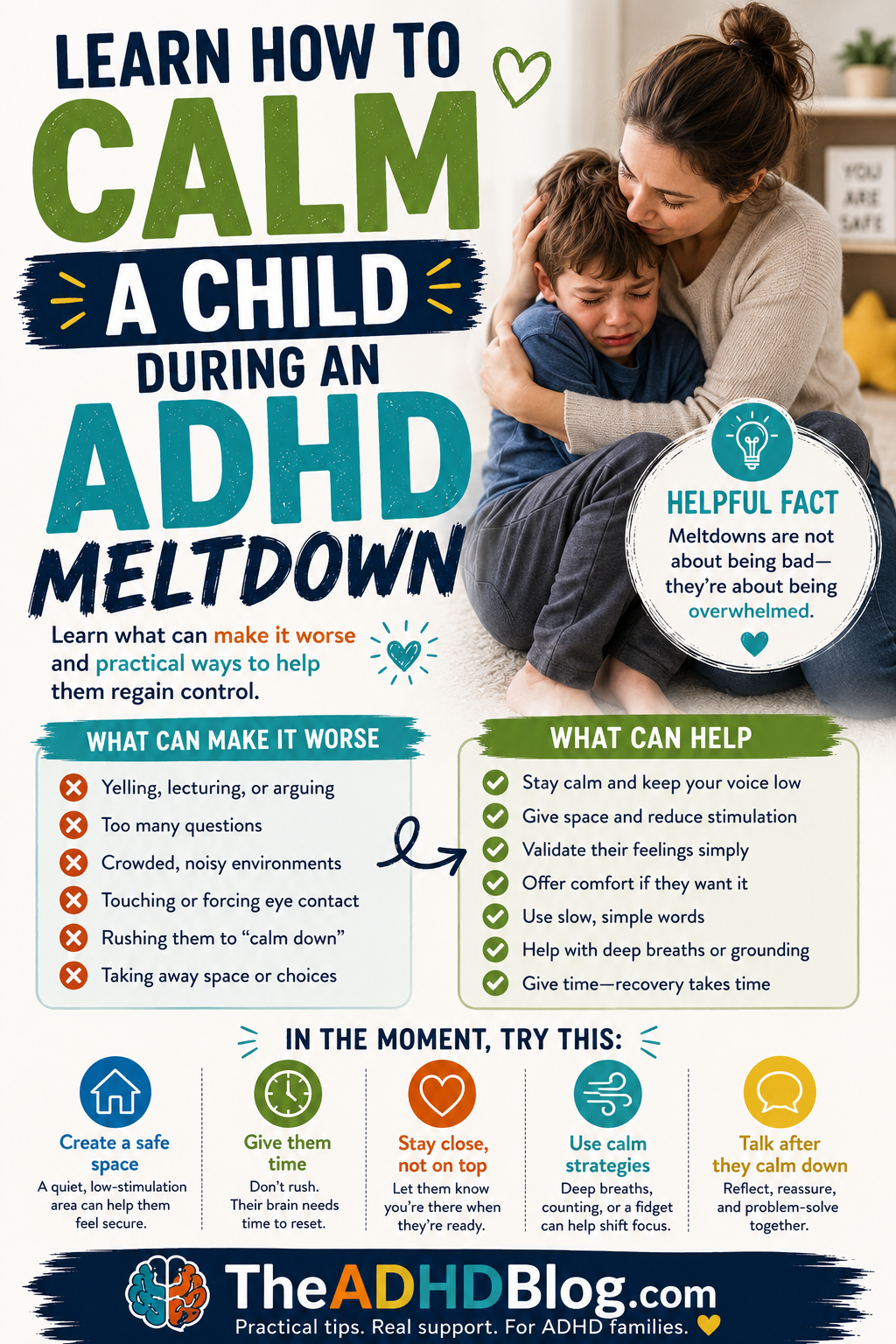
Help the situation become safe and calm enough for my child’s ability to think and communicate to come back online.
CHADD’s guidance on ADHD meltdowns emphasizes that reasoning can be ineffective when a child is intensely dysregulated, while remaining calm, reducing talking, showing empathy, and recognizing what the individual child needs can be more helpful.
That completely changes how I approach the worst part of a meltdown.
First, Make Sure Everyone Is Safe
Before anything else, I look at safety.
Is the child hitting?
Throwing something?
Running toward a dangerous area?
Trying to hurt themselves?
Is a sibling getting involved?
Are there objects nearby that could become dangerous?
If everyone is physically safe, I have much more freedom to give the meltdown some room to come down naturally.
If someone isn’t safe, then safety takes priority over every other strategy in this article.
I can talk about feelings later.
I can talk about consequences later.
I can figure out why the meltdown happened later.
First, I need everyone safe.
I Stop Trying to Win the Argument
This may be one of the hardest changes I’ve made.
A meltdown often starts with a disagreement.
“Turn the game off.”
“NO!”
“You’ve already had enough time.”
“NO I HAVEN’T!”
“I told you ten minutes ago.”
“THAT’S NOT FAIR!”
Now I’m irritated because I know I’m right.
And maybe I am.
But being right doesn’t mean continuing the argument is going to help the child calm down.
Once I recognize that we’ve moved beyond ordinary disagreement and into genuine dysregulation, I stop trying to prove my case.
The rule can still exist without me defending it for the next 20 minutes.
The game is still off.
We just aren’t debating why right now.
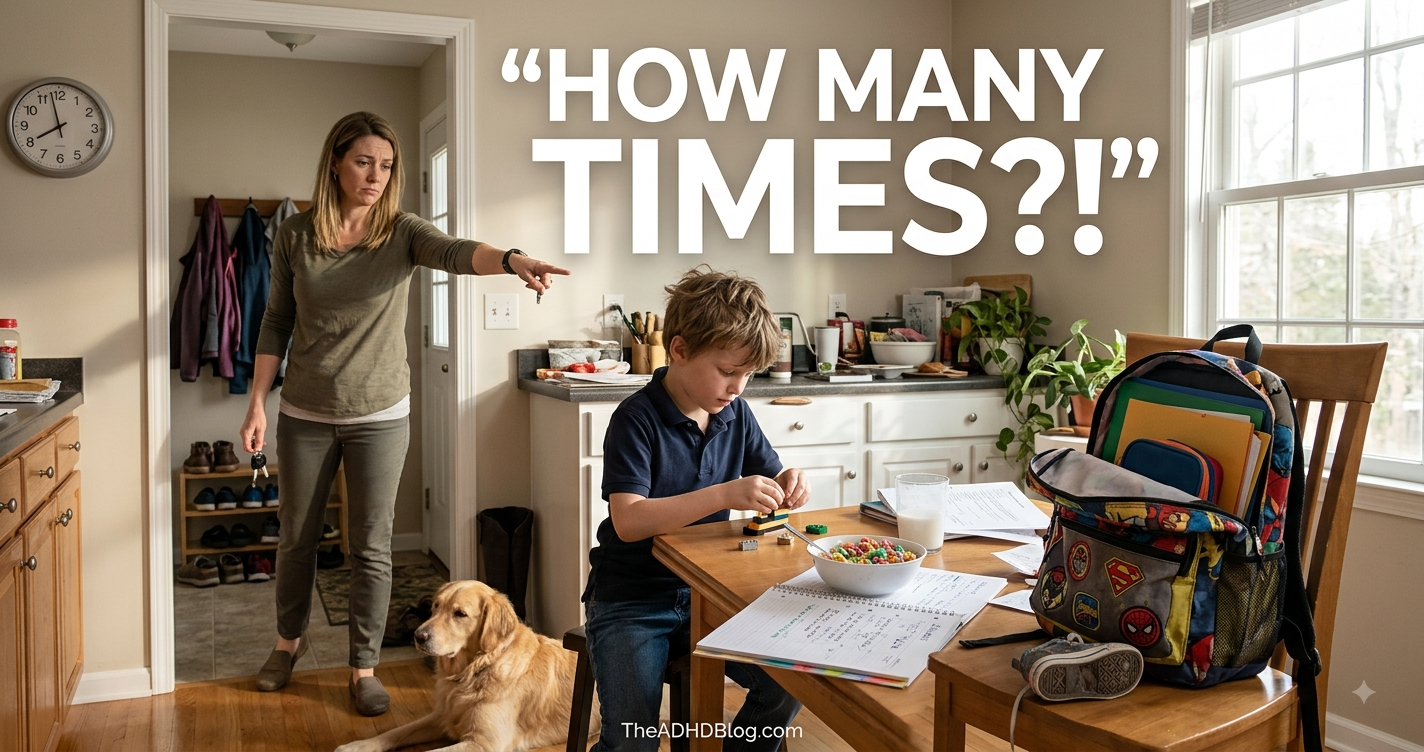
I Use Far Fewer Words During an ADHD Meltdown
This is probably one of the most useful things I’ve learned.
My natural instinct is to talk.
Explain.
Ask questions.
Correct.
Reason.
Offer solutions.
But imagine already feeling completely overwhelmed while somebody keeps pouring more language into your brain.
It can become another demand.
CHADD specifically recommends reducing verbal input during intense ADHD dysregulation because trying to reason through the situation while the child is overwhelmed may add to that overload.
So instead of:
“I don’t understand why you’re getting this upset because I already told you yesterday that we had to leave at five and you’ve known all afternoon that…”
I want something closer to:
“I know you’re upset.”
Then stop.
Sometimes silence is actually doing more work than another paragraph would.
I Lower My Voice Instead of Raising It
This sounds simple.
Doing it when someone is screaming at you is another story.
When a child gets louder, there’s a natural tendency for adults to increase their own volume.
We need to be heard.
Then the child gets louder.
So we get louder.
Before long, nobody is regulating anybody.
CHADD notes that a parent’s own arousal can contribute to a child’s arousal, and recommends calm interactions and a quieter voice when helping children regulate strong emotions.
I think of my voice almost like a thermostat.
I don’t want to match the temperature already in the room.
I want to gradually turn it down.
I Don’t Keep Saying “Calm Down”
I’ve never seen the phrase:
“CALM DOWN!”
magically produce a calm child.
Usually it seems to accomplish the opposite.
If the child knew exactly how to calm themselves in that moment, we probably wouldn’t be having the meltdown.
So rather than repeatedly telling them what emotional state I want, I try to create conditions that make reaching that state easier.
Less talking.
Less noise.
Less confrontation.
Less pressure.
More time.
More space when that’s what the child needs.
That feels much more useful than simply demanding calm.
Sometimes I Need to Stop Asking Questions
This was another mistake I didn’t immediately recognize.
“What’s wrong?”
“Why are you crying?”
“What happened?”
“What do you want?”
“Do you want to go upstairs?”
“Do you want water?”
“Are you hungry?”
“Why won’t you answer me?”
I’m trying to help.
But I’ve just turned calming down into a quiz.
A child who is completely overwhelmed may not even know exactly what’s wrong yet.
Sometimes they need the intensity to come down before they can explain anything.

Give Physical Space When That’s What Your Child Needs
Some children want closeness when they’re overwhelmed.
Others absolutely do not.
That’s why I don’t think there’s one universal ADHD meltdown technique.
If your child doesn’t want to be touched, trying to hug them because hugs are supposed to be calming may make the situation worse.
CHADD recommends giving physical space when it can be done safely during intense dysregulation.
For one child, that might mean sitting nearby without talking.
For another, it might mean allowing them to go somewhere quiet.
For another, it may mean remaining close enough that they know you’re available without crowding them.
I want to learn my child’s pattern, not force a generic calming strategy onto them.
Reduce Whatever Stimulation You Can
If we’re already dealing with an overloaded child, I don’t want the environment adding more.
Turn down the television.
Move arguing siblings somewhere else.
Reduce unnecessary talking.
Dim things down if bright surroundings seem to be contributing.
Leave the busy environment if that’s practical and safe.
Stop five different adults from trying to help at once.
The American Academy of Pediatrics recommends reducing distractions and overstimulation as part of behavioral support for children with ADHD.
Sometimes the environment isn’t what caused the meltdown.
But changing the environment can still make recovering from it easier.
Don’t Assume the Original Trigger Is the Whole Problem
This is one of the most important things we’ve covered throughout this cluster.
A child explodes because you gave them the wrong cup.
It looks ridiculous.
Except maybe they slept badly.
School was difficult.
Lunch barely got eaten.
A friend upset them.
The classroom was loud.
Homework is waiting.
They’re exhausted.
And then the wrong cup appears.
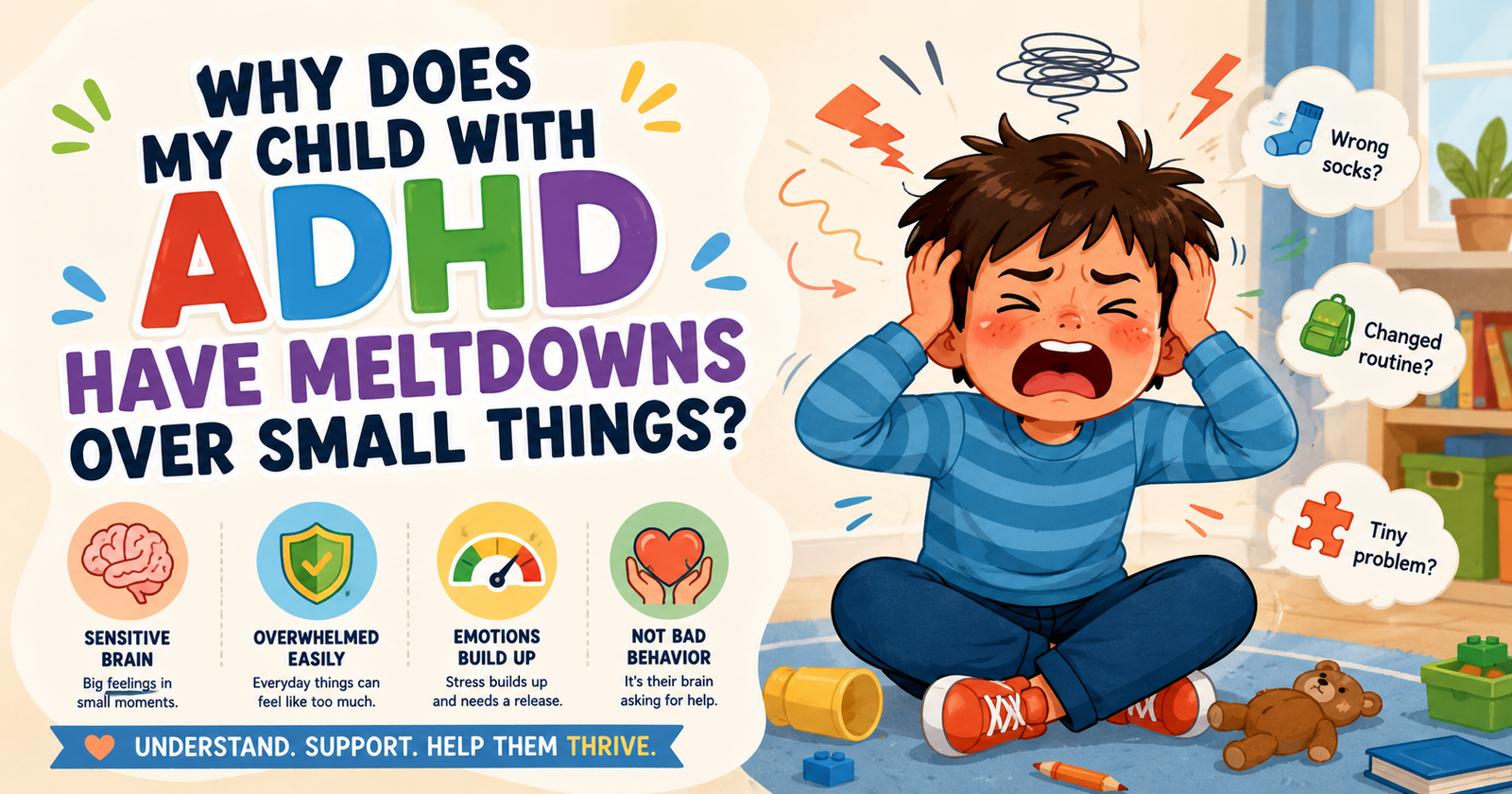
That’s why I wrote why children with ADHD can have meltdowns over seemingly small things.
Sometimes the little thing we’re staring at is only the final drop.
If I understand that, I’m much less likely to stand there arguing:
“It’s JUST A CUP!”
Because the cup may barely matter anymore.
ADHD Anger May Need the Same Approach
Some meltdowns look mostly like crying and overwhelm.
Others look like pure anger.
That can be much harder for parents to respond to calmly because anger tends to pull anger out of us.
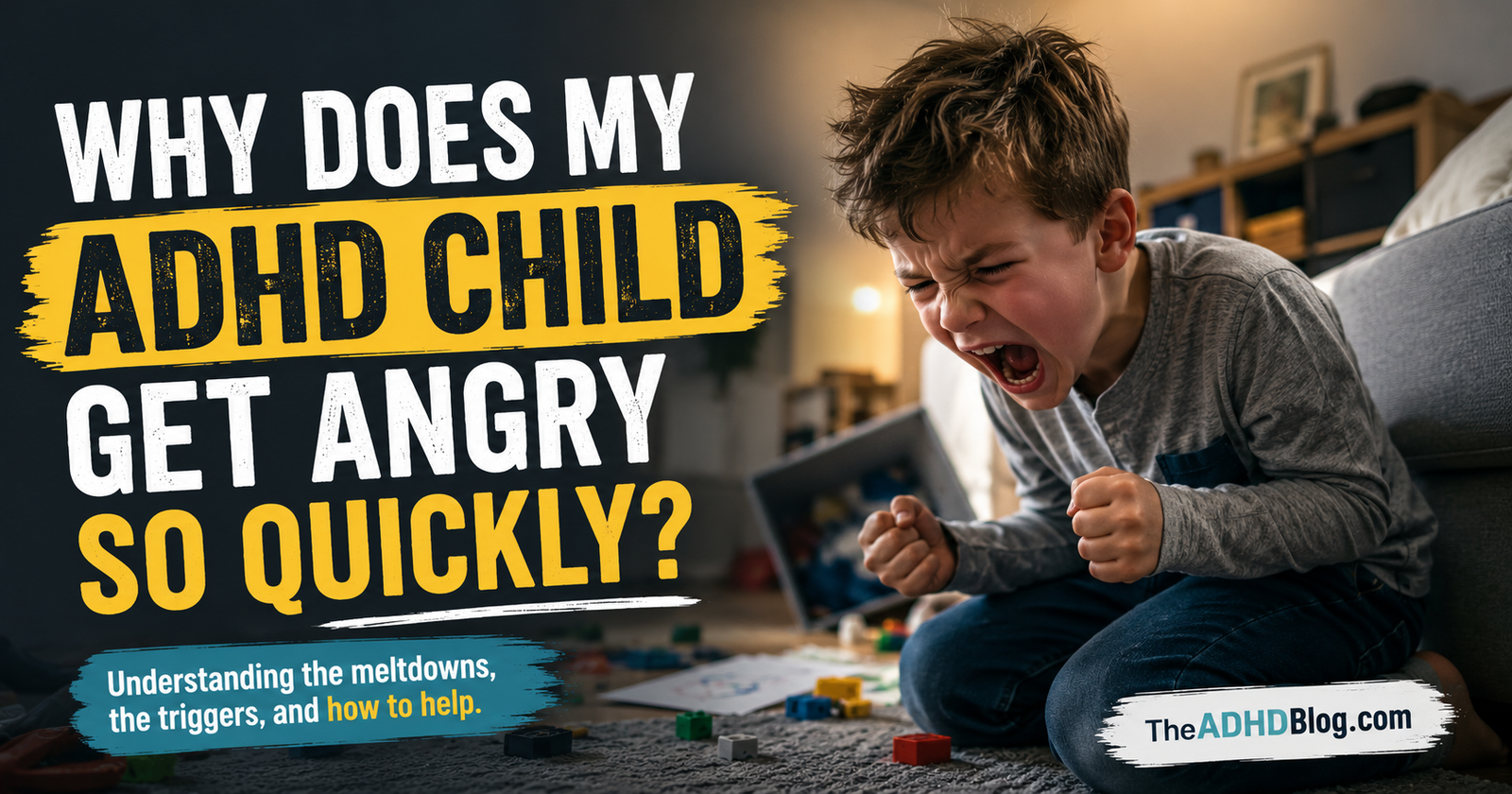
If that’s the pattern you’re dealing with, I went deeper into why an ADHD child can get angry incredibly quickly.
Understanding that rapid frustration doesn’t mean accepting aggression.
I can say:
“I know you’re furious.”
and also:
“You cannot hit.”
Both statements can exist at the same time.
Feelings don’t need punishment.
Dangerous behavior still needs boundaries.

Don’t Try to Teach the Lesson Yet
This one deserves its own section.
Let’s say the meltdown started because your child threw homework across the room.
Eventually, the screaming begins settling.
This is where it’s tempting to say:
“See? If you would’ve just done your homework when I asked, none of this would have happened.”
And we’re off again.
I try not to use the first 30 seconds of calm to immediately revisit everything that went wrong.
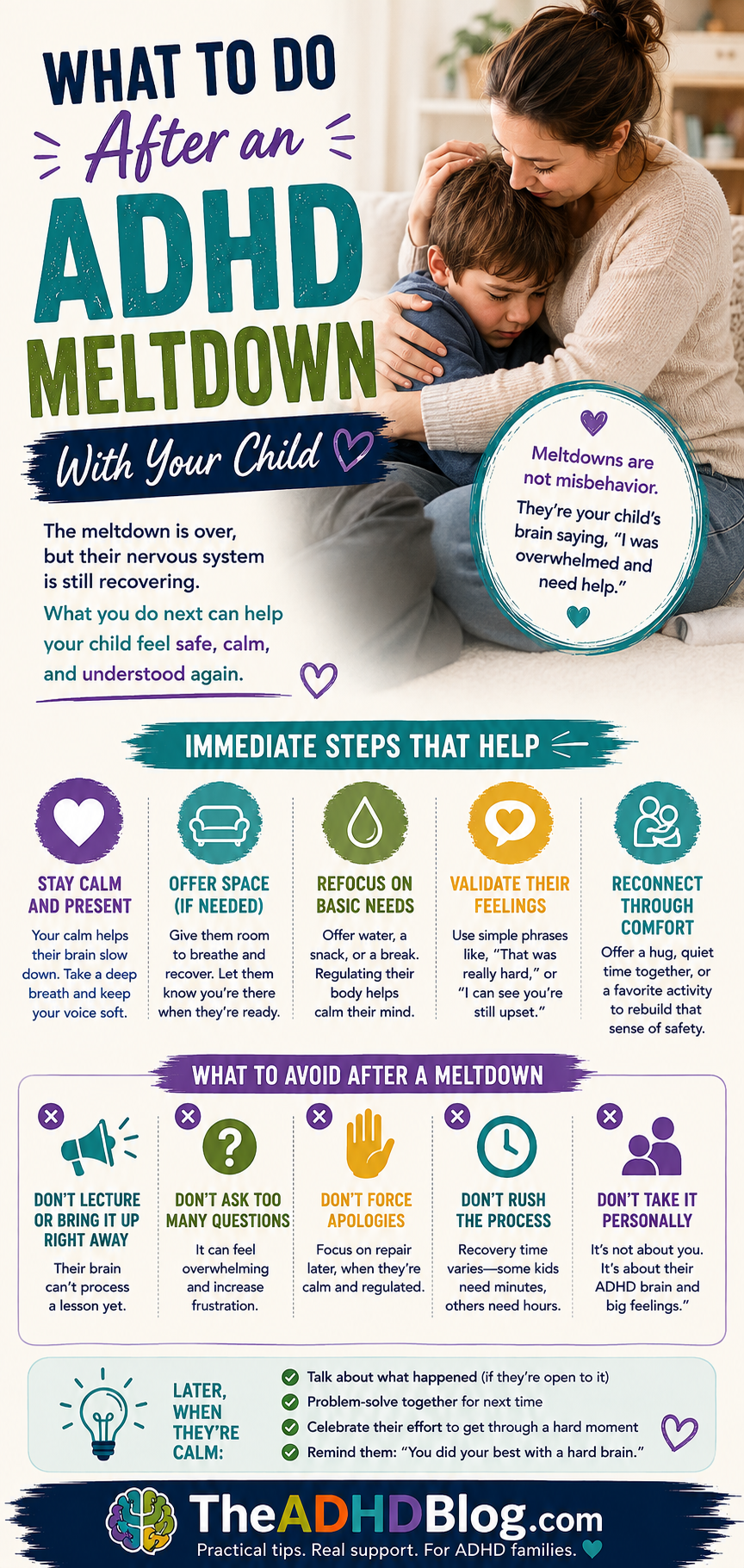
CHADD recommends discussing difficult situations after a child has had time to calm and reflect, rather than attempting to teach emotional skills during the height of dysregulation. Once the immediate crisis has passed, what to do after an ADHD meltdown can help parents approach reflection without restarting the conflict.
Calm first. Teach later.
That’s probably the simplest sentence I could give a parent dealing with ADHD meltdowns.
Watch for Signs the Meltdown Is Starting to Come Down
I don’t need my child to suddenly announce:
“I have now completed my emotional regulation process.”
I’m looking for little changes.
The yelling becomes less intense.
They stop pacing.
Their breathing slows.
They sit down.
They start responding to simple things I say.
They accept some water.
They let me sit closer.
They stop repeating the same statement.
Their body looks less tense.
Those are wins.
We may not be finished yet, but we’re heading the right direction.
Don’t Rush the Recovery
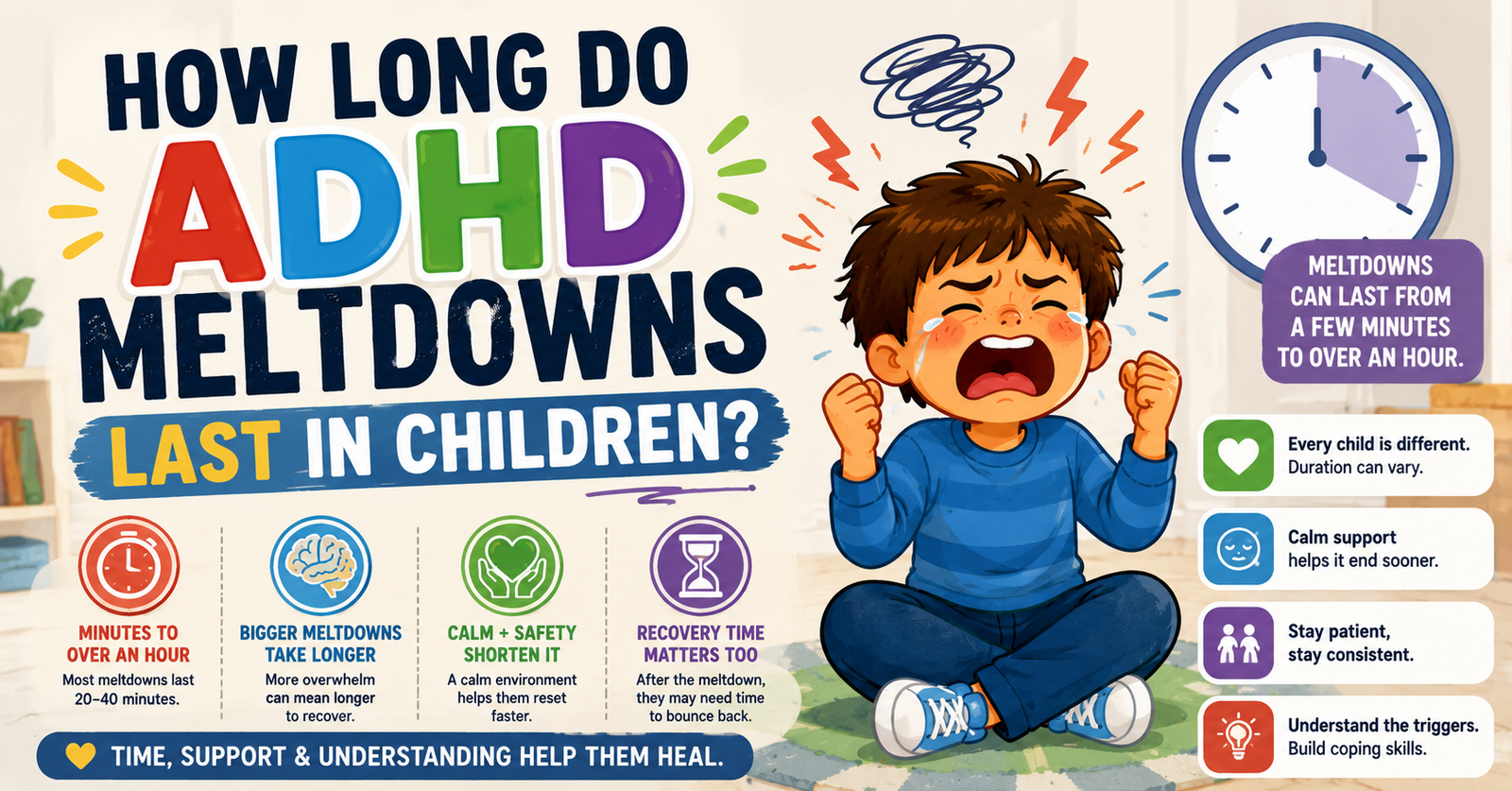
One thing I learned while researching how long ADHD meltdowns can last in children is that the most intense part isn’t necessarily the entire event.
A child can stop screaming and still be emotionally worn out.
CHADD notes that the more intense a meltdown becomes, the more time may be needed for physiological arousal to diminish.
So I don’t automatically interpret:
No longer yelling
as:
Ready for demands again.
Sometimes there’s a recovery period.
What If My Child Wants to Be Alone?
If they’re safe, sometimes that’s exactly what they need.
This is where knowing your child matters tremendously.
Some children regulate through connection.
Others need less input.
CHADD specifically notes that some children with ADHD may need to be left alone for a period to regulate and recover.
I wouldn’t turn that into:
“Fine! Go to your room!”
That’s very different emotionally.
Instead, it can be:
“I’ll give you some space. I’m here when you’re ready.”
Same physical result.
Completely different message.
What If My Child Wants Me Close?
Then I can be close.
For younger children especially, regulation can be something they need help doing with another person. CHADD describes this as needing a “regulation partner,” sometimes beyond the earliest childhood years.
Maybe I sit nearby.
Maybe we breathe together.
Maybe we eventually walk outside.
Maybe the child wants a hug once they’re ready.
Again, I don’t want to force my favorite calming technique.
I want to learn what reliably helps this child.
Movement Can Help Some ADHD Kids Calm Down
Not every child wants to sit perfectly still and breathe deeply.
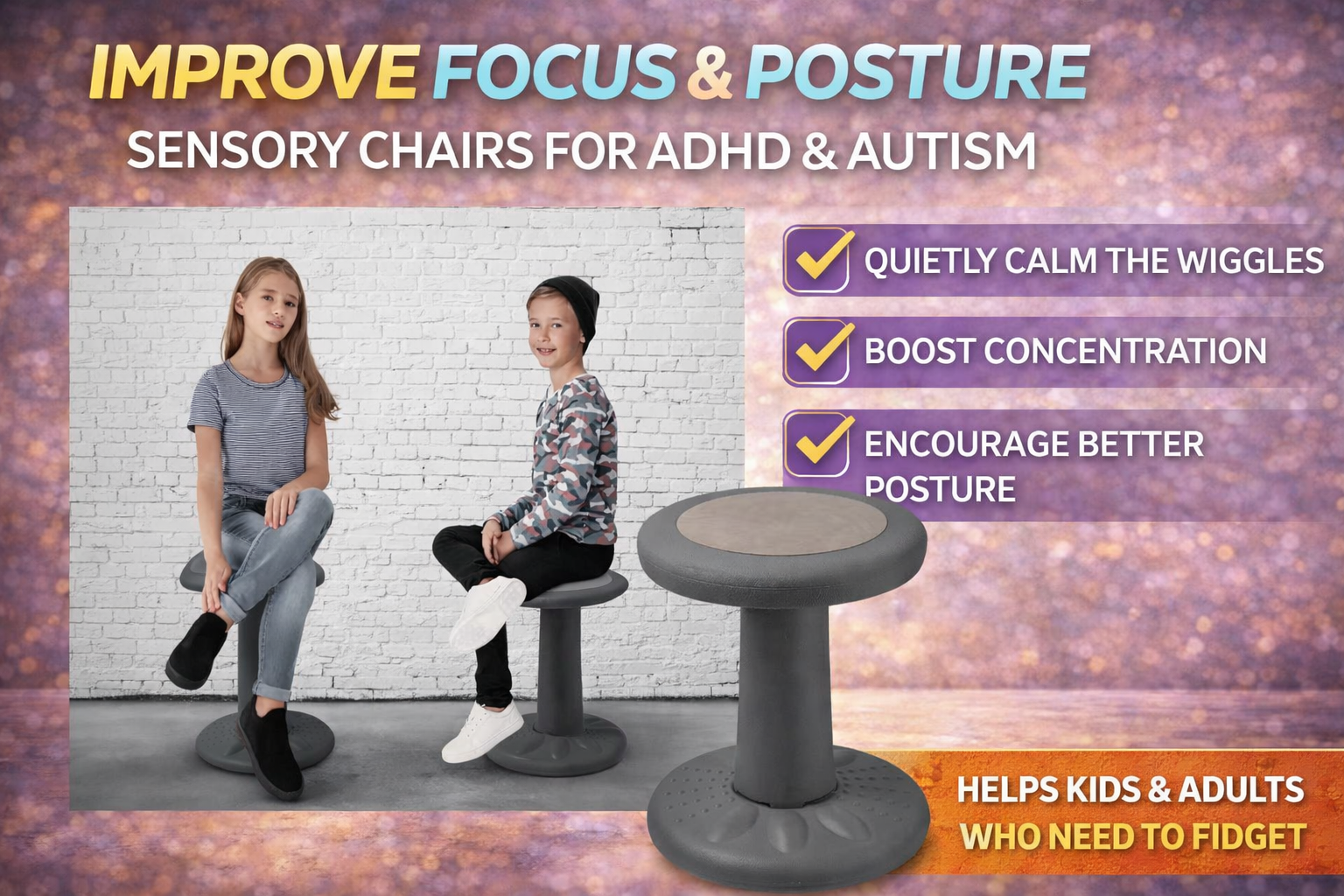
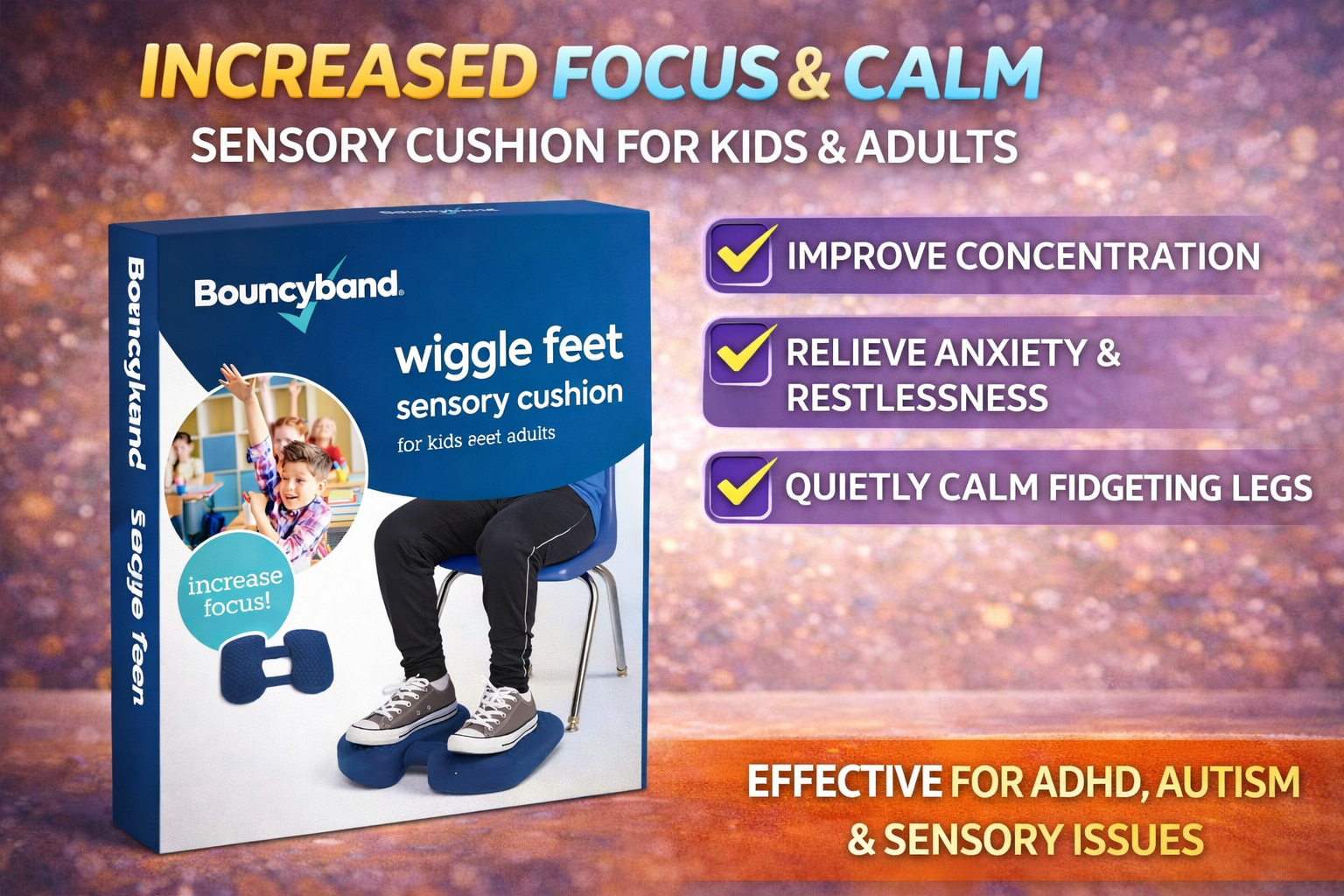
Movement may actually work better for some kids. A movement-friendly classroom seat can provide that movement in a more controlled way when a child needs to stay seated during class or homework.
Walking.
Going outside.
Running.
Stretching.
Jumping.
Doing something physical in a safe way.
CHADD includes exercise and outdoor activity among strategies that can help some children regulate strong emotions.
That makes intuitive sense with ADHD too.
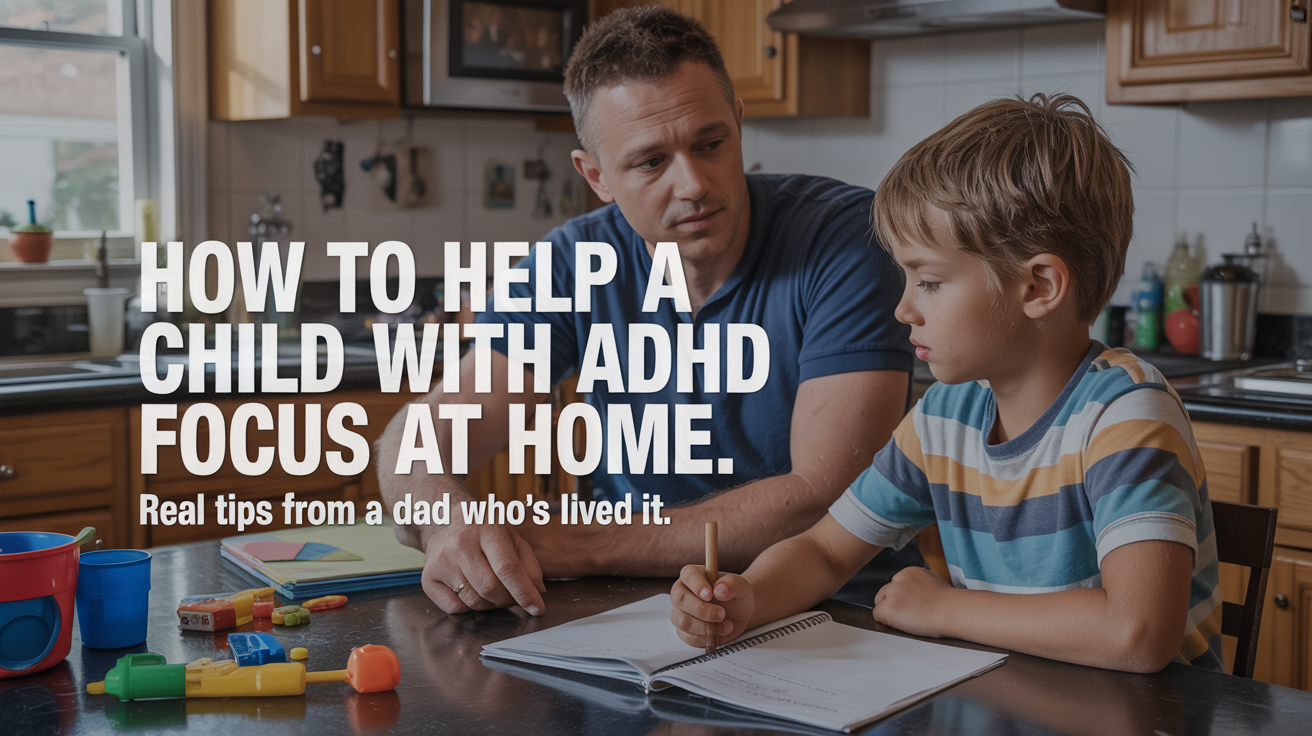
If the child’s whole body seems like it’s exploding with energy and frustration, quietly sitting in a chair may not be their best route back down. A broader look at movement-friendly focus ideas can help parents consider alternatives to demanding stillness during difficult moments.
Don’t Force Eye Contact
This is another thing I wouldn’t make into a battle during a meltdown.
“LOOK AT ME WHEN I’M TALKING TO YOU.”
Why?
What are we accomplishing?
If the child is already overwhelmed, requiring eye contact adds another demand.
I care much more about reducing the intensity and getting everyone regulated than whether the child is looking directly at my face.
There will be plenty of opportunities for conversations later.
What If My Child Keeps Repeating the Same Thing?
This can be incredibly frustrating.
“I WANT MY TABLET!”
You’ve answered.
“I WANT MY TABLET!”
You’ve explained.
“I WANT MY TABLET!”
You explain again.
“I WANT MY TABLET!”
At some point, continuing to provide increasingly detailed explanations isn’t accomplishing anything.
I can acknowledge it once.
“I know you want it. Tablet time is finished.”
Then I don’t need to keep reinventing the answer.
The boundary isn’t changing.
Neither is my explanation.
What If the Meltdown Started Because I Said No?
Saying no doesn’t automatically make the reaction a tantrum.
This distinction can get complicated.
A child can initially be upset because they didn’t get what they wanted and then become genuinely overwhelmed.
That’s why our guide to ADHD meltdowns vs tantrums is worth reading if you’re struggling to tell what you’re seeing.
Either way, I don’t think the answer is giving in to every demand just to stop difficult emotions.
The child can be upset.
The boundary can remain.
And I can still help them regulate.
Be Careful About Giving In Just to End the Meltdown
This is an important balance.
Let’s say the meltdown starts because your child wants another hour of video games.
If every enormous reaction results in another hour of video games, we may unintentionally teach something very different from emotional regulation.
Behavior therapy for ADHD commonly involves setting clear expectations and consistently reinforcing desired behavior.
So I separate two questions:
Does my child need help calming down?
Yes.
Does that automatically mean the original boundary disappears?
No.
We can be compassionate without making every rule negotiable under enough pressure.
A Meltdown Doesn’t Automatically Mean Manipulation Either
The opposite mistake is assuming every meltdown is calculated.
A child can genuinely lose emotional control.
CHADD’s discussion of ADHD meltdowns describes them as a significant loss of control rather than simply a deliberate attempt to manipulate a parent.
That’s important.
I don’t have to choose between:
“My child should be allowed to do anything because they have ADHD.”
and
“My child is intentionally doing this to control me.”
There’s a huge amount of space between those two extremes.
Sensory Overload May Change What Helps
If noise, crowds, clothing, lighting, or other sensory input repeatedly seems connected to your child’s meltdowns, I’d pay attention.
That information matters.
It doesn’t automatically tell you whether the child has ADHD, autism, both, or something else.
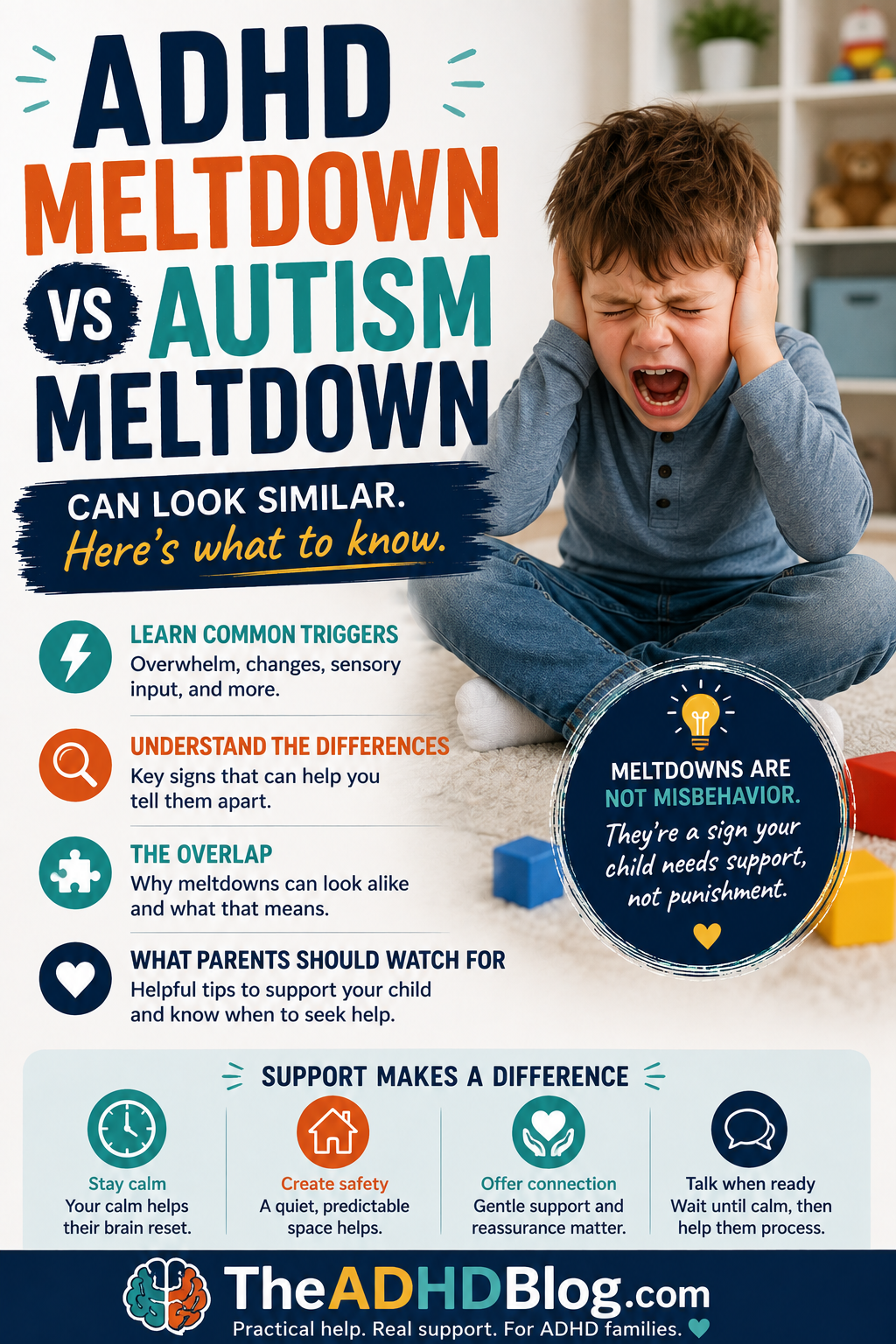
We’ve covered this distinction in much more depth in ADHD meltdowns vs autism meltdowns.
During the actual meltdown, though, I don’t need to solve the diagnostic question.
If getting somewhere quieter clearly helps my child regulate, that’s useful information right now.
Homework Meltdowns Need More Than Calming Techniques
Sometimes the best way to handle a meltdown is to change the problem that keeps causing it.
Homework is a perfect example.
If homework creates an explosion every night, I don’t want to become amazing at surviving homework meltdowns.
I want fewer homework meltdowns.
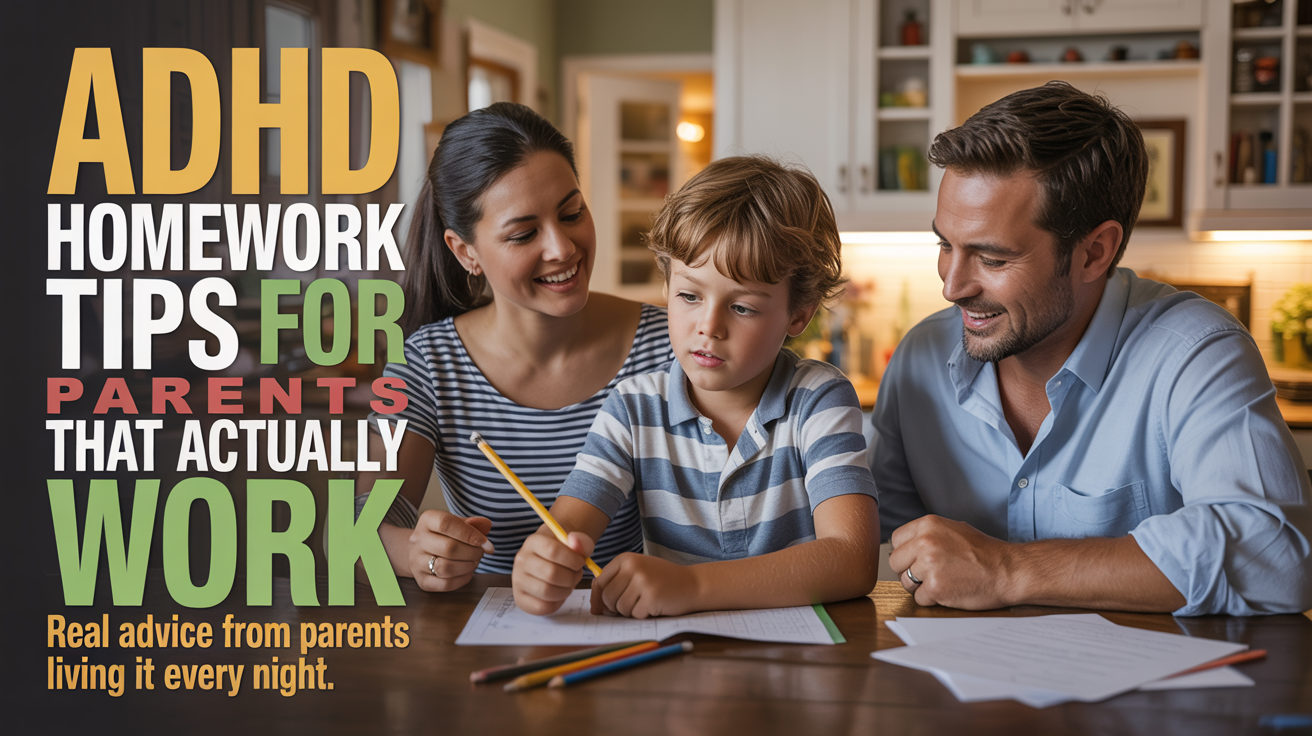
That’s where our ADHD homework tips for parents become important.
Maybe assignments need smaller chunks.
Maybe the child needs movement first.
Maybe they need help starting.
Maybe breaks need to be planned.
Maybe the environment is too distracting.
Calming the child tonight matters.
Fixing the recurring trigger matters too.
Bedtime Meltdowns Need the Same Thinking
If the worst meltdown happens every night at bedtime, that’s a pattern.
I’d want to know why.
Is the child overtired?
Not tired enough?
Having trouble stopping screens?
Anxious about bedtime?
Unable to settle their brain?
Fighting a complicated routine?
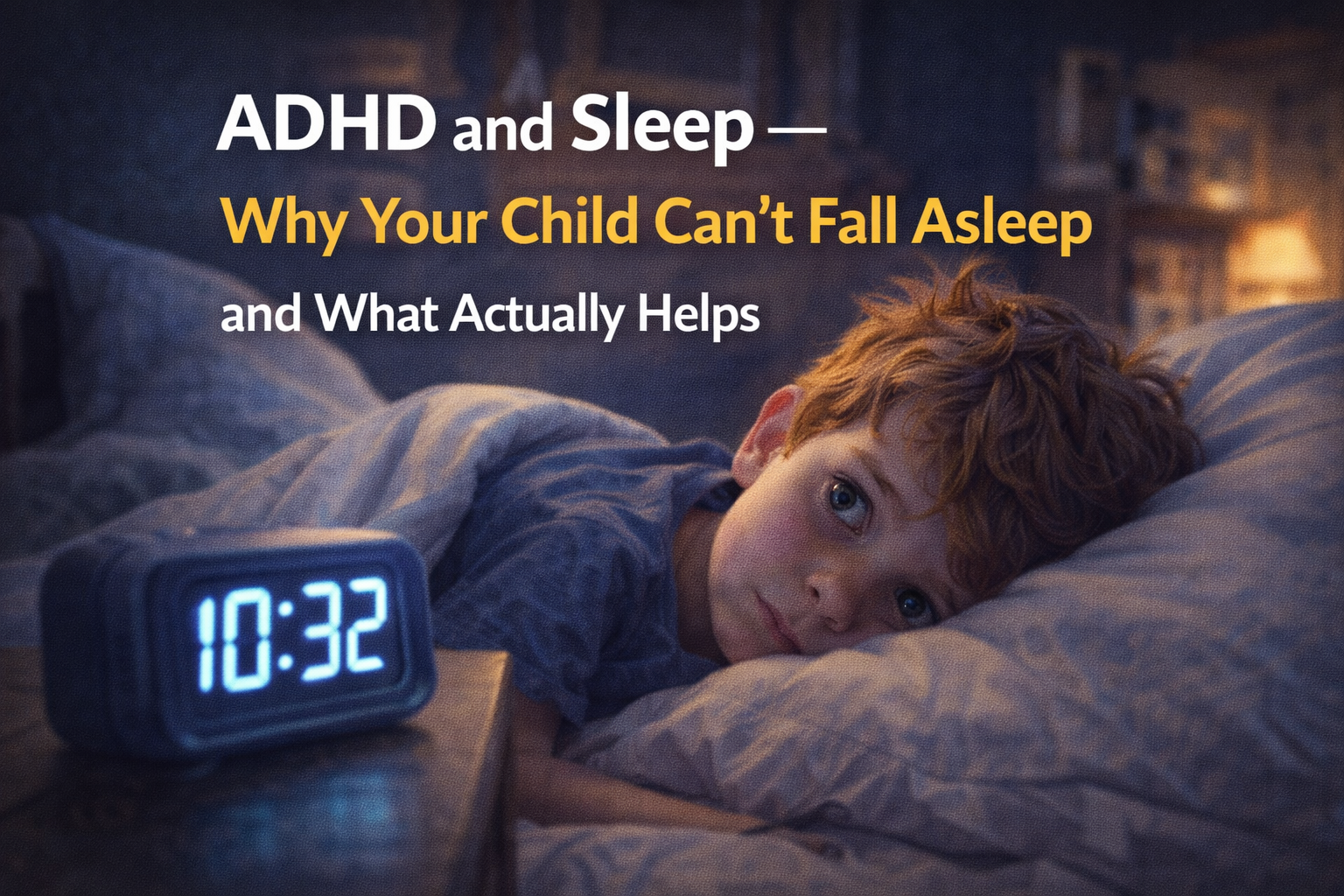
We have separate guides on ADHD and sleep problems in children and the ADHD bedtime battles we’ve worked throughbecause bedtime can become a whole ADHD problem of its own.
If I can reduce the recurring trigger, I may not need as many emergency calming strategies.
The Best Time to Practice Calming Skills Isn’t During a Meltdown
This seems obvious once you think about it.
If I want my child to use a strategy while they’re upset, we should probably practice it while they’re not upset.
Maybe it’s:
Taking a break.
Going somewhere quiet.
Walking outside.
Naming the emotion.
Asking for help.
Using a breathing technique.
Getting movement.
Saying:
“I’m getting really mad.”
Whatever strategy works for that child, I want it familiar before they desperately need it.
CHADD recommends helping children develop emotional vocabulary and a list of safe coping strategies, while modeling appropriate regulation ourselves.
We’re building a skill through repetition.
Learn Your Child’s Early Warning Signs
This is where I think we can eventually make the biggest difference.
Maybe your child’s face changes.
Their voice gets louder.
They start pacing.
Everything suddenly becomes irritating.
They repeatedly say they can’t do something.
They cover their ears.
They become extremely rigid.
They begin arguing about everything.
Those are the moments I want to recognize.
CHADD recommends identifying a child’s individual signs of escalating arousal and introducing calming strategies before the problem becomes overwhelming.
Because helping a child who is at a 5 out of 10 is much easier than trying to bring them back from a 10.
Create a Calm-Down Plan When Nobody Is Upset
I like the idea of figuring this out ahead of time.
Not during a meltdown.
Later.
Maybe I ask:
“When you get really upset, what helps?”
The answers might surprise me.
Maybe the child hates being talked to.
Maybe they want to go to their room.
Maybe music helps.
Maybe walking outside helps.
Maybe they want me nearby but don’t want questions.
Maybe squeezing something helps.
Maybe they genuinely don’t know yet.
That’s okay.
We can experiment.
The important part is that we’re building the plan with a calm brain.
I Want to Know What Happened Afterward, Not During It
Once everyone has genuinely recovered, that’s when I want to learn.
“That got really hard earlier.”
“What happened?”
“Were you already upset before I told you to turn the game off?”
“What made things worse?”
“Did anything help?”
“What should we try next time?”
Those conversations can teach both of us something.
Maybe I discover that the meltdown wasn’t really about screen time.
Something happened at school.
Now the entire afternoon makes more sense.
Praise the Recovery Too
This is easy to forget.
We’re so relieved that the meltdown ended that everyone just moves on.
But if the child eventually did something useful, I want to notice it.
“You were really upset, but you came and talked to me when you were ready.”
“I noticed you went somewhere quiet instead of throwing something.”
“You got angry and eventually asked for help.”
Positive reinforcement is a major component of behavioral approaches for children with ADHD.
If I want a behavior to happen more often, noticing it when it happens makes sense.
What If Nothing Seems to Calm My Child?
Sometimes there isn’t a magic trick.
That can be frustrating to hear when you’re desperate for one.
Your job may simply be to create a safe environment, reduce unnecessary stimulation, stay as regulated as you reasonably can, and give the child’s system time to come down.
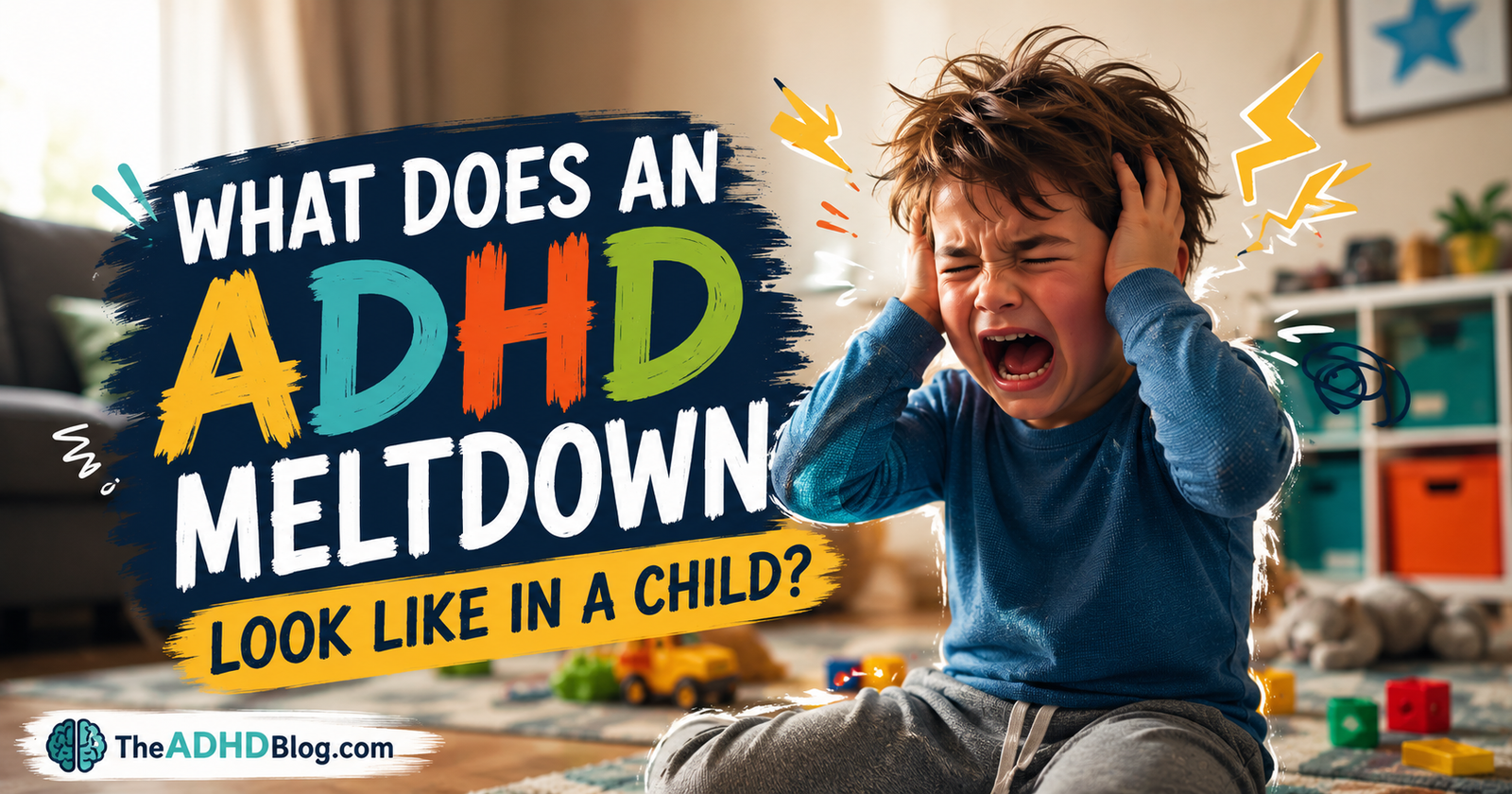
That’s also why knowing what an ADHD meltdown actually looks like in a child can be so useful.
You’re not necessarily looking for a button that instantly stops it.
You’re looking for signs that the child is gradually regaining control.
When ADHD Meltdowns Need More Than Home Strategies
There comes a point where I wouldn’t keep trying new internet tips.
If meltdowns are extremely frequent, worsening, causing injuries, involving serious aggression, self-harm or threats, major property destruction, significant school problems, or making family life unsafe, I would talk with the child’s pediatrician or a qualified mental health professional.
CHADD recommends professional help when dysregulation remains severe despite supportive strategies or involves frequent threatening or dangerous behavior.
Parent training in behavior management can also be valuable. The American Academy of Pediatrics describes behavior therapy as an approach that teaches parents and caregivers practical ways to set expectations, reinforce positive behavior, respond consistently, and improve interactions with children who have ADHD.
Getting help doesn’t mean you’ve somehow failed to figure out your child.
Sometimes the problem needs more tools than one exhausted parent can reasonably invent alone.
My Goal Isn’t to Make My Child Stop Having Feelings
This is probably the distinction I care about most.
I don’t want to teach:
Anger is bad.
Crying is bad.
Frustration is bad.
Those are normal emotions.
I want to teach:
You can be angry without hurting someone.
You can be frustrated and ask for help.
You can feel overwhelmed and take a break.
You can be disappointed and eventually recover.
And during an ADHD meltdown, sometimes my child isn’t capable of practicing all of those skills yet.
That’s okay.
That’s when I become the calmest part of the situation I can reasonably manage.
I keep everyone safe.
I stop arguing.
I use fewer words.
I reduce stimulation.
I give space when space helps.
I stay nearby when connection helps.
And I save the teaching for when we both have brains capable of learning again.
Because I’ve learned that calming an ADHD meltdown isn’t really about finding the perfect sentence that makes the child stop.
It’s about creating the conditions that help them slowly regain the control they’ve temporarily lost.
About the Author: Emily Parker
Emily Parker writes for TheADHDBlog.com about raising and supporting children with ADHD, with a special focus on emotional regulation, anger, meltdowns, family routines, and the difficult everyday moments parents are trying to understand. Her articles combine practical parent-focused strategies with guidance from established ADHD and pediatric resources, helping families recognize patterns, build useful skills, and know when additional professional support may be appropriate. For more context on the personal perspective behind these practical articles, visit our family-focused ADHD perspective.