
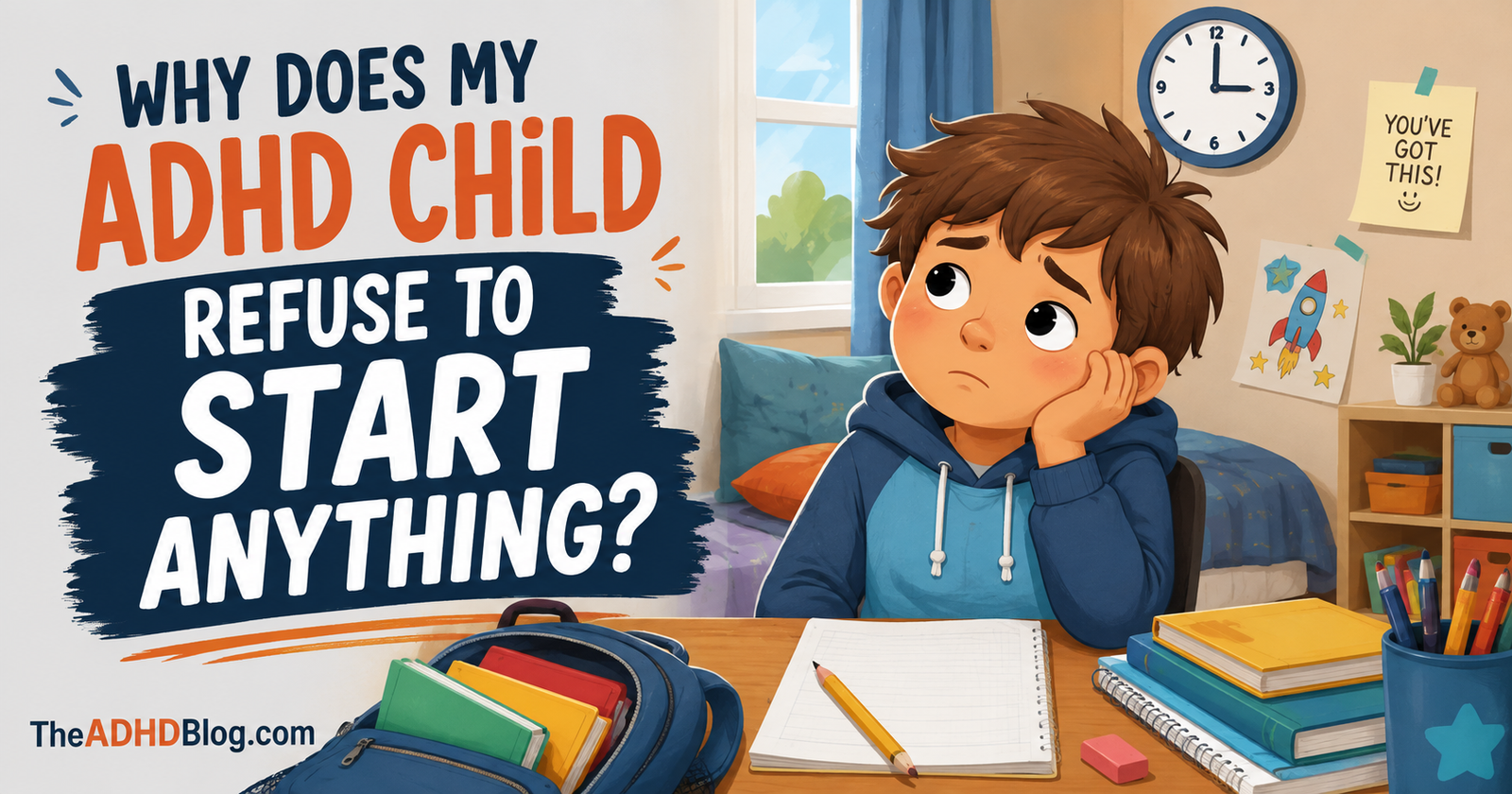
The homework is sitting there.
The pencil is sharpened. The worksheet is open. My child knows exactly what needs to happen next.
And somehow we’ve been sitting here for 20 minutes without a single answer written down.
I’ve seen the same thing happen with chores.
“Go clean up the toys.”
My child knows how to clean them up.
Nothing happens.
“Go get dressed.”
They know we’re leaving.
Still nothing.
Then I remind them. And remind them again. Eventually I’m frustrated because the task itself would have taken less time than we’ve already spent not doing it.
That’s when it becomes very easy to interpret the behavior as refusal.
They’re stalling.
They’re being lazy.
They’re trying to get out of it.
They simply don’t care.
And yes, sometimes kids absolutely do avoid things they don’t want to do. Having ADHD doesn’t mean every unwanted chore suddenly becomes impossible.
But I’ve learned that there’s another possibility worth considering:
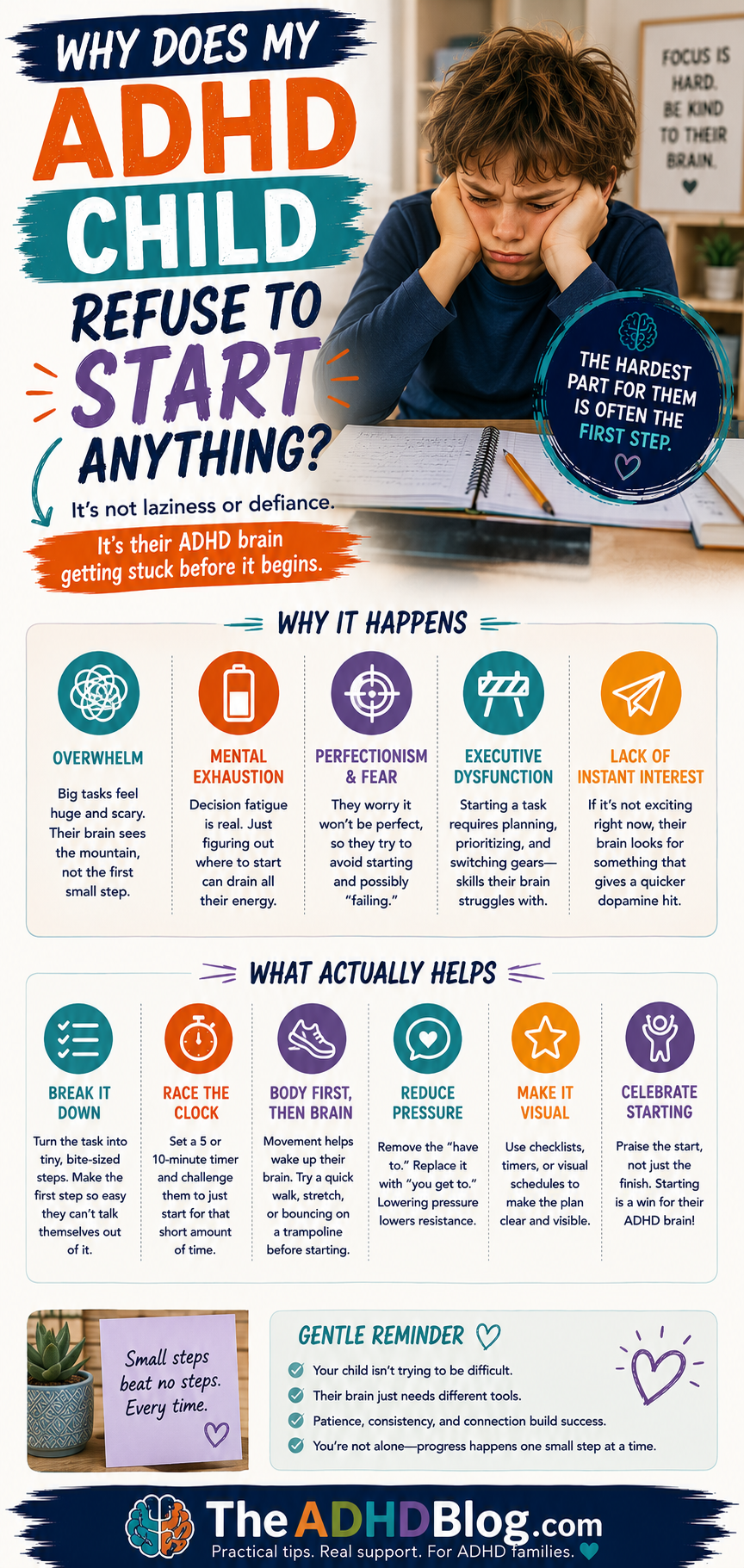
My child may know exactly what needs to be done and still have trouble getting themselves across that invisible line between thinking about a task and actually starting it.
Task initiation is often discussed as part of executive functioning, and difficulties beginning tasks can show up alongside the organizational, attention, and follow-through problems associated with ADHD. ADHD diagnostic criteria also include avoiding or being reluctant to engage in tasks requiring sustained mental effort, being easily distracted, having difficulty organizing tasks, and being forgetful in daily activities.
Once I understood that, “Just start!” stopped feeling like much of a strategy. A broader guide to replacing frustration with workable support is available in understanding what helps your child.
Knowing What to Do Doesn’t Mean My Child Can Easily Start Doing It
This is probably the most confusing part.
If my child doesn’t understand a math problem, I can understand why they’re stuck.
But what about putting socks on?
Opening the backpack?
Picking up clothes?
Brushing teeth?
These are things they’ve done hundreds of times.
That’s why task initiation can look so much like defiance from the outside.
The child has the ability to perform the task.
The problem appears at the moment when they have to activate themselves and begin.
Think about how many times adults do this too.
I know I need to answer an email.
It might take three minutes.
I’ve thought about it eight times.
Yet somehow I keep doing something else.
The fact that a task is easy doesn’t necessarily make starting it easy.
For some kids with ADHD, that gap can show up over and over throughout the day.


The Hardest Part May Literally Be the First 30 Seconds
I’ve noticed that some tasks become dramatically easier once my child is actually moving. For seated activities where movement may be part of getting engaged, an active wobble chair for movement may be worth considering.
Homework is a battle until the first problem gets answered.
Cleaning is impossible until the first five things are picked up. For the household version of this problem, an ADHD cleaning checklist can turn an overwhelming room into a short sequence of visible steps.
Getting ready takes forever until clothes actually start going on.
Then suddenly there’s momentum.
That’s important information.
If the child can continue reasonably well after beginning, I don’t necessarily have a problem with the entire task.
I may have a problem with the starting point.
And that’s a much smaller problem to solve.
Instead of asking:
“How do I make my child do 30 minutes of homework?”
I can start with:
“How do I help my child begin question one?”


Sometimes “I Don’t Want To” Really Means “This Feels Too Big”
I’ve heard:
“I don’t want to.”
“This is stupid.”
“I hate homework.”
“I’m not doing it.”
Sometimes that’s exactly what the child means.
Other times, I think those statements can cover something else.
They don’t know where to start.
There are too many steps.
They’re worried it’s going to be difficult.
They remember how frustrating it was yesterday.
They’re tired.
They’re already overwhelmed by looking at the entire assignment.
So instead of immediately arguing about attitude, I want to find out whether the task itself needs to be shrunk.
The CDC recommends helping children with ADHD plan by breaking complicated tasks into simpler, shorter steps. For longer tasks, starting earlier and taking breaks can also help reduce stress.
That’s a lot more actionable than telling a stuck child to try harder.
Make the First Step Almost Ridiculously Small
This has become one of my favorite approaches.
If the bedroom is a disaster, I don’t necessarily start with:
“Clean your room.”
I might say:
“Grab every dirty shirt you can see.”
That’s it.
Homework?
“Get your math folder out.”
Not:
“Do your homework.”
Getting ready?
“Put your socks on.”
Not:
“Get completely ready because we’re leaving.”
Once the first action happens, I can give the next one.
I’m trying to create movement.
Because sometimes movement creates more movement.
This Is Different From Starting Something and Never Finishing It
These two problems can look similar, but I think they deserve separate attention.
One child sits in front of the task and can’t seem to begin.
Another starts immediately but gets distracted halfway through.
And plenty of kids do both depending on the situation.
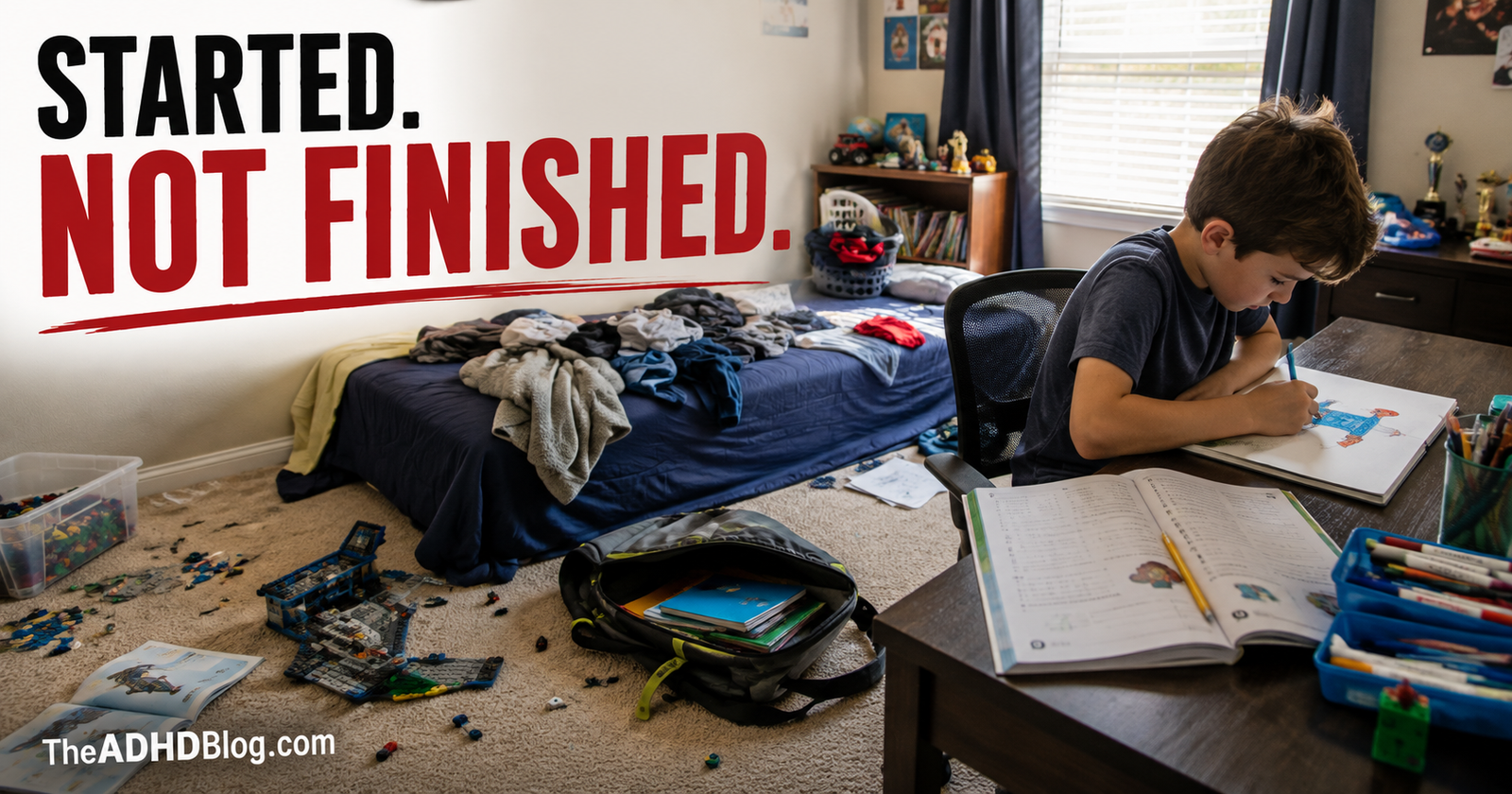
We just covered that second problem in why an ADHD child starts things but never finishes them.
Here, I’m interested in what happens before the task has even begun.
If the pencil hasn’t touched the paper, the laundry basket hasn’t moved, and the shoes still aren’t going on, I don’t need a strategy for persistence yet.
I need ignition.
Transitions Can Make Starting Even Harder
Sometimes I think my child is refusing homework when the bigger problem started five minutes earlier.
They were playing.
Now I’m asking them to stop playing and begin homework.
That’s actually two executive demands.
Stop one activity.
Start another.
The starting problem may be tangled together with a transition problem.
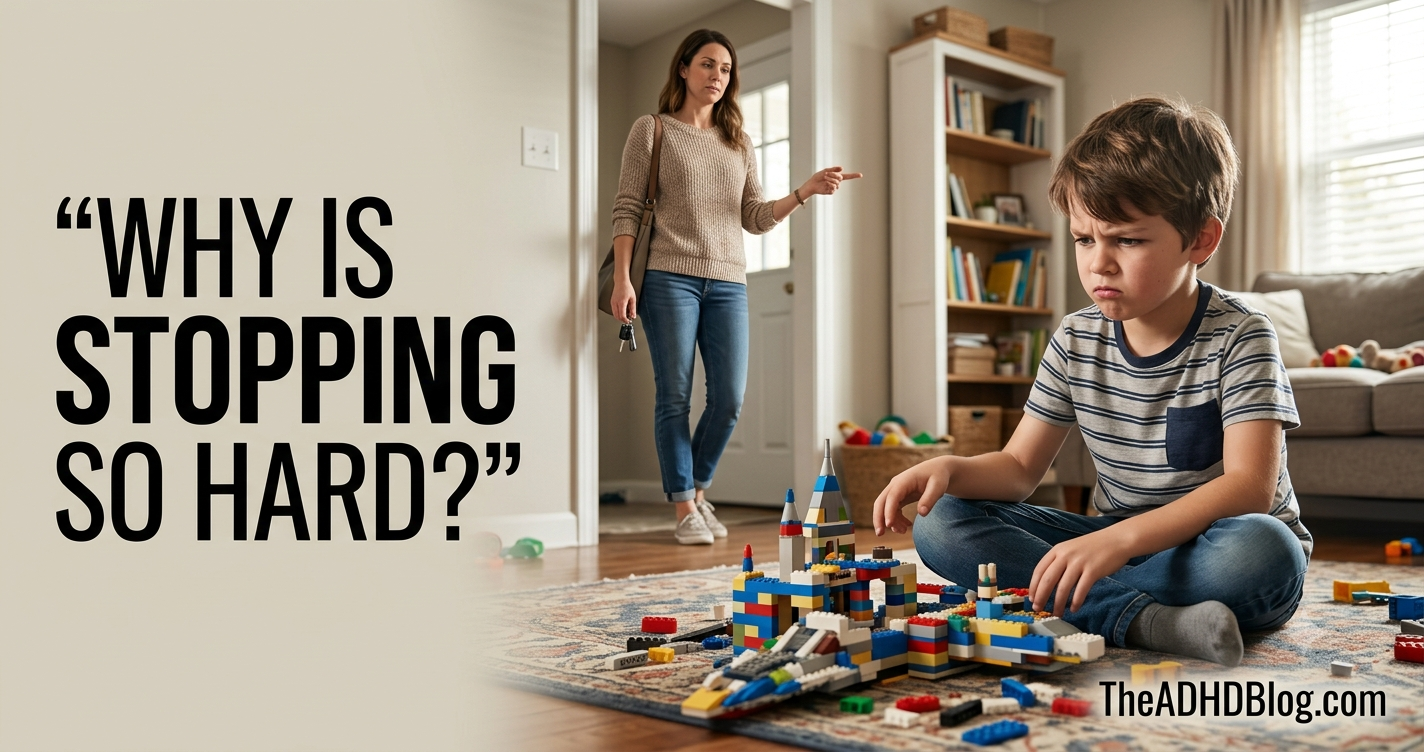
That’s why transitions can be especially difficult for kids with ADHD, particularly when they’re moving away from something interesting and toward something they find less rewarding.
I may get better results by preparing for that transition before homework time arrives.
“Ten more minutes, then we’re setting up homework.”
Now the change isn’t appearing out of nowhere.


Going From Something Fun to Something Boring Is a Rough Combination
This one seems obvious once I say it.
Video game to math worksheet.
Playing outside to shower.
YouTube to cleaning a bedroom.
LEGO to getting dressed.
I’m asking the child to stop something that currently has their attention and voluntarily initiate something that doesn’t.
That’s a much different situation from:
“Stop cleaning your room. We’re going for ice cream.”
I still expect boring things to get done.
Life contains plenty of boring things.
But I don’t need to pretend motivation has nothing to do with how difficult starting feels.
Don’t Accidentally Give Your Child an Entire Project When You Mean One Task
Here’s one of my own mistakes:
“Go get ready for bed.”
That’s not really one task.
It might mean putting toys away, changing clothes, putting dirty clothes in the hamper, using the bathroom, brushing teeth, getting water, choosing a book, and getting into bed.
If my child stalls, maybe the instruction itself is part of the problem.
The CDC recommends clear, brief directions for children with ADHD, along with breaking more complicated jobs into smaller steps.
So maybe:
“Pajamas first.”
That’s much easier to begin.
Sometimes I Need to Stop Talking and Start Beside Them
There are times when another verbal reminder does absolutely nothing.
“Start your homework.”
“Come on.”
“You need to start.”
“I’ve told you three times.”
At some point I’m simply producing more words.
Instead, I might walk over, sit down, open the folder, and say:
“Let’s see what you have tonight.”
I’m not doing the homework.
I’m helping create the beginning.
Once the first question is underway, I can step back.
That small amount of presence can sometimes be enough to get a stalled task moving.
Why Does My ADHD Child Only Start When I Stand There?
This can be incredibly frustrating.
You walk away.
Nothing.
You come back.
Nothing.
You stand beside them.
Suddenly the task begins.
That can make it seem like the child is deliberately forcing us to supervise them.
But I don’t automatically interpret it that way.
Another person’s presence can provide structure, accountability, reminders, and an immediate anchor to the task.
The long-term goal is still independence.
I just may need to build toward it gradually.
Today I sit beside them until they begin.
Later I might say:
“Get started. I’ll check back in five minutes.”
Eventually, maybe the routine itself is enough.
Support doesn’t have to disappear all at once.


Give the Child a Clear Finish Line Before They Start
Starting something feels harder when I don’t know when it’s going to end.
Imagine somebody says:
“Go work on this.”
For how long?
Until when?
How much?
A child may see an entire worksheet and immediately feel defeated.
Instead:
“Do these first five problems, then we’ll check them.”
That’s finite.
Or:
“We’re cleaning for ten minutes.”
Or:
“Put these clothes away, then you’re done.”
The CDC recommends realistic goals and small steps for children with ADHD, along with praise or other positive reinforcement for progress.
I want my child to be able to see the other side of the task before they’re expected to jump into it.
Homework Is Probably the Classic Starting Battle
There may be no better example than homework.
The backpack is home.
The assignment exists.
The child knows it needs to happen.
Yet getting from after-school mode into homework mode can become the hardest part of the entire evening.
I’ve found it helpful to stop thinking about homework as one single behavior.
There are many possible breakdown points: knowing what was assigned, having the correct materials, deciding when to work, beginning the assignment, sustaining attention, checking the work, packing it up, and actually turning it in.
The American Academy of Pediatrics recommends examining those individual steps when homework is going poorly because the solution depends on where the process is breaking down.

Our ADHD homework tips for parents go much deeper into making the whole process more manageable.
The Best Homework Environment May Surprise You
I used to assume the perfect homework environment would be completely silent.
No television.
No movement.
No distractions.
Just a desk and the assignment.
That may work beautifully for one child and terribly for another.

The American Academy of Pediatrics notes that there’s no single ideal homework environment for every child with ADHD. Some may actually work more efficiently around a little activity rather than being isolated in a completely quiet room. A quiet foot cushion can provide that small amount of movement while keeping the child’s body engaged without adding much classroom disruption.
That’s why I want to watch the child instead of automatically creating the environment I think should work.
Where do they actually start easiest?
At the kitchen table?
At a desk?
With me nearby?
After moving around?
After a snack?
Those patterns matter.
A Routine Can Eliminate the Daily Decision About When to Begin
This is one of the reasons routines help so much.
Without a routine, homework requires another decision.
When am I doing it?
Now?
Later?
After this video?
After dinner?
After one more game?
Every opportunity to decide can become another opportunity to delay.
A predictable routine changes the question.
Maybe after school we have a snack, get some movement, and then homework starts.
The CDC recommends consistent daily routines for children with ADHD, while the American Academy of Pediatrics similarly emphasizes predictable routines and structured environments.

That’s also why our ADHD morning routine helped with mornings.
I don’t want every necessary task to require a fresh negotiation.
Sometimes My Child Is Waiting Until the Task Feels Urgent
This pattern is fascinating.
A project is due in two weeks.
Nothing.
One week.
Nothing.
Three days.
Still very little.
Then suddenly it’s due tomorrow and my child can work like their life depends on it.
That can make parents crazy because it proves the child can do the work.
But urgency has changed the environment.
The deadline is no longer abstract.
The consequence is immediate.
There’s no longer much room for deciding whether to start.
CHADD describes task initiation as the ability to begin work efficiently without procrastinating, and notes that longer-range deadlines can create particular difficulty for students struggling with initiation.
I don’t want my child relying on panic as their lifelong productivity system.
So for bigger projects, I try to create smaller deadlines along the way.
Create Artificial Starting Points Before the Real Deadline
Suppose a project is due Friday.
Instead of:
“Finish your project by Friday.”
we might create several smaller targets.
Monday is choosing the topic.
Tuesday is gathering information.
Wednesday is the first section.
Thursday is finishing and checking.
Now we’re creating multiple concrete starting points instead of waiting for Friday’s urgency to do all the motivational work.
This is especially useful for school projects where the deadline feels so far away that starting today seems pointless.
Don’t Let “Later” Become an Unlimited Time Zone
“I’ll do it later.”
Okay.
When?
That’s the important question.
Later can mean anything.
If my child isn’t starting right now but there’s a reasonable reason to delay, I want an actual starting point.
“Okay. Homework starts at 4:30.”
Or:
“Finish your snack, then start.”
Now we have a trigger.
That’s very different from:
“I’ll do it sometime.”
Visual Timers Can Make the Beginning More Concrete
For some kids, time is too abstract.
“Start in ten minutes” may not feel particularly meaningful.
A visible countdown can help make the transition real.
I can also use a timer for the work itself.
“We’re starting with ten minutes.”
Suddenly the child isn’t committing to an endless homework experience.
They’re beginning a defined period.
The timer isn’t magic, but it can make both start and stop more visible.
Chores Need a Starting Point Too
Chores create exactly the same issue.
“Clean your room.”
My child stands in the doorway.
Where do they begin?
There’s stuff everywhere.

This is where our article on ADHD chores for kids and what actually works fits naturally.
Instead of waiting for the child to create a cleaning strategy from scratch, I can give the first target.
“Trash first.”
When that’s done:
“Now dirty clothes.”
Suddenly we’re not cleaning an entire room.
We’re finding trash.
That’s a task with an obvious beginning.
Sometimes Choice Helps, but Too Much Choice Makes Things Worse
I like giving children some control.
But:
“What do you want to start with?”
may not help a child who’s already overwhelmed.
Now they have another decision to make.
The CDC specifically recommends limiting choices to only a few options when too many choices may overwhelm a child with ADHD.
So I might say:
“Do you want to start with math or spelling?”
Two options.
Both acceptable.
The child gets control without having to organize the entire evening.
Don’t Mistake a Delayed Start for Forgetting
These problems overlap, but they’re not identical.
Sometimes my child genuinely forgot the instruction.

We’ve already gone deeply into why an ADHD child may forget everything you tell them.
But other times they haven’t forgotten at all.
They know.
I remind them and they say:
“I KNOW!”
They’re completely aware of the task.
They’re simply not starting it.
That’s useful information.
Another reminder about what they need to do probably isn’t solving a problem they have.
I need to help with how to begin.
This Is How Parents End Up Saying the Same Thing 10 Times
Task initiation can also be hiding underneath constant reminders.
I say:
“Put your shoes on.”
Nothing.
So I repeat it.
Nothing.
Repeat.
Repeat.
Repeat.
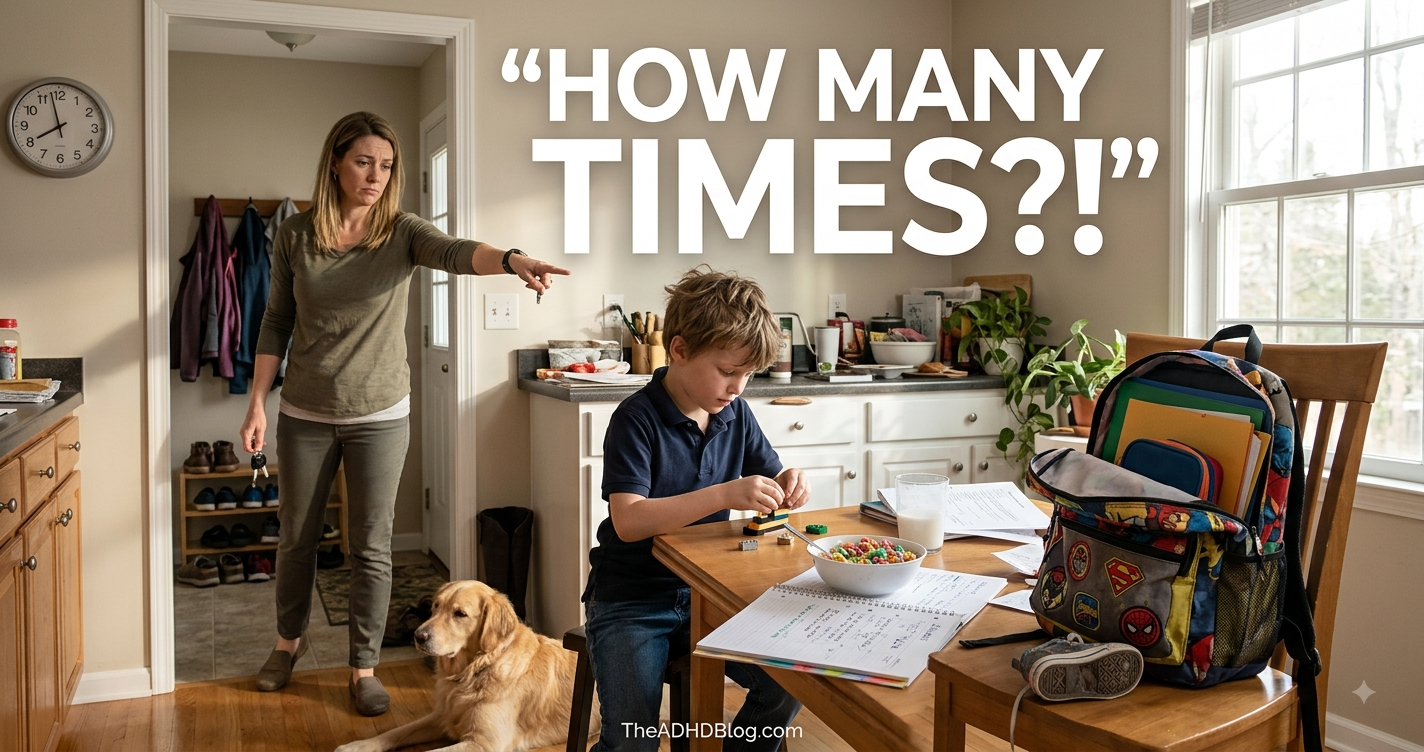
Eventually I’m wondering why my ADHD child has to be told everything 10 times.
But if my child heard the first instruction and remembers it, reminders two through ten may not be addressing the actual problem.
Maybe I need to walk over and say:
“Shoes. Let’s get the first one on.”
Again, we’re creating movement rather than adding words.
Avoid Turning the Starting Problem Into a Character Problem
This is probably one of the most important things I want to remember.
A child who struggles to begin things can hear a lot of unpleasant descriptions.
Lazy.
Unmotivated.
Doesn’t care.
Never listens.
Has no work ethic.
Some of those labels can follow a child for years.
I’d rather describe the actual behavior.
“You haven’t started the worksheet yet.”
That’s true.
And fixable.
“You’re lazy.”
That’s an identity.
It doesn’t tell the child what to do differently.
Correction Can Make a Stuck Child Even More Stuck
This is where task initiation can collide with emotional regulation.
The child isn’t starting.
I become frustrated.
My voice changes.
They feel criticized.
Now instead of dealing with homework, we’re dealing with hurt feelings, defensiveness, or anger.

For children who have especially strong reactions to feedback, our guide on why an ADHD child gets so upset when corrected explains that pattern much more deeply.
The original task hasn’t disappeared.
We’ve simply added an emotional problem on top of it.
Taking It Personally Can Completely Derail the Task
Sometimes I say:
“You still haven’t started.”
My child hears:
“You think I’m bad.”
Now we’re discussing whether I’m angry, whether I think they’re lazy, and why I always supposedly criticize them.

That’s why understanding why some ADHD children take everything personally matters even in something as ordinary as homework.
I want to keep the feedback focused on the behavior.
“The worksheet is still blank. Let’s start number one.”
We’re returning to something concrete.
Praise the Start When Starting Is the Skill We’re Practicing
This sounds almost too basic.
But if beginning is genuinely the hard part, I want to notice successful initiation.
“You came home, got your snack, and started homework without me reminding you. Nice job.”
That’s specific.
I’m not praising intelligence.
I’m reinforcing the behavior we’re trying to strengthen.
Behavior therapy for ADHD commonly uses positive reinforcement, structure, clear expectations, and consistent strategies to build desired behaviors.
If independent starting is the goal, that’s what I want to reinforce.
Gradually Reduce How Much Help You Give at the Beginning
Maybe today I have to sit beside my child and help open the assignment.
That doesn’t mean I’ll be doing that when they’re 17.
Next, maybe I sit nearby but don’t help.
Then I say:
“Get started. I’ll check back in five minutes.”
Eventually, the routine or alarm may become the cue instead of me.
I think of this as scaffolding.
I provide enough support for the child to successfully practice the skill, then gradually reduce the support as they become more capable.
The destination is still independence.
I’m just not expecting independence to appear instantly because I demanded it.
What If My Child Flat-Out Says “No”?
This is where I don’t want to overcorrect in the other direction.
Not every refusal is an executive-function problem.
Kids sometimes refuse.
They test limits.
They want to keep playing.
They don’t like the task.
They hope we’ll give up.
ADHD doesn’t mean I eliminate expectations or consequences.
I can acknowledge that starting may be difficult while still holding the boundary.
“I know you don’t want to do homework. It still needs to be done. Do you want to start with math or spelling?”
I’m not debating whether homework exists.
I’m helping create a manageable way into it.
What If Starting Leads Straight to a Meltdown?
Sometimes a task has accumulated so much frustration that merely mentioning it produces an enormous reaction.
Now we’re beyond ordinary procrastination.
Maybe homework has become associated with failure.
Maybe the child is already exhausted.
Maybe the work is genuinely too difficult.
Maybe we’re seeing an emotional-regulation problem layered on top of the initiation problem.
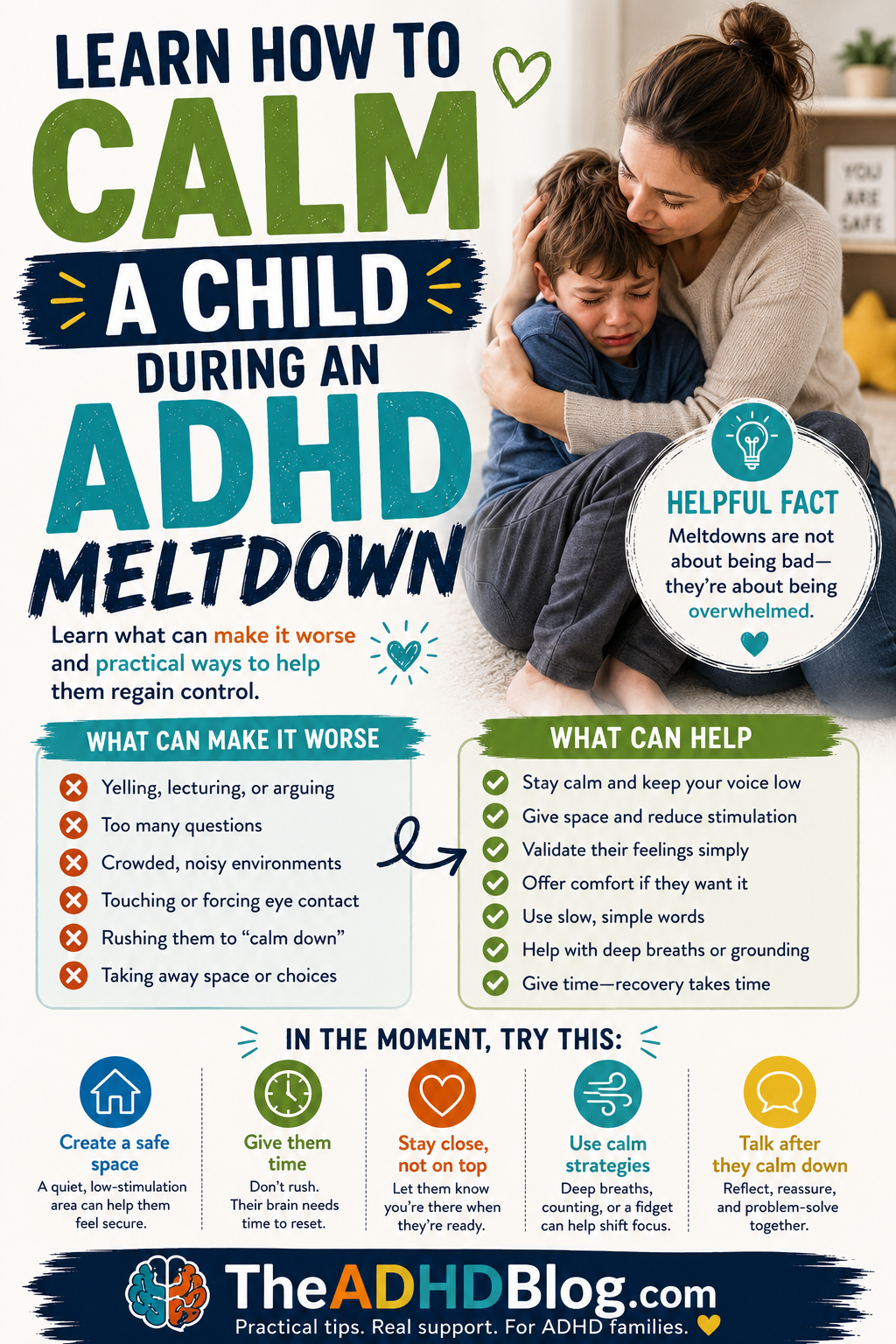
If the child becomes significantly dysregulated, our guide on how to calm a child during an ADHD meltdown explains why I shift away from debating and lecturing once the child is overwhelmed.
Later, I want to figure out why this particular task has become such a powerful trigger.
If Schoolwork Is Always Impossible to Start, Look Deeper
This deserves attention.
If my child will eventually start ordinary household tasks but becomes completely stuck every time reading or math appears, I don’t automatically assume ADHD explains everything.
Maybe the work is too difficult.
Maybe there’s a learning problem.
Maybe the child is embarrassed that they don’t understand it.
Maybe anxiety has developed around the subject.
Maybe they can do the work but the amount is overwhelming.
ADHD can occur alongside learning disabilities, anxiety, depression, sleep problems, and other concerns, and evaluation involves considering whether another condition could better explain or contribute to the symptoms.
Sometimes “won’t start” is actually “doesn’t know how to do this and doesn’t want anyone to know.”
That’s something I definitely want to uncover.
The School Can Help With Task Initiation Too
If the problem shows up in class, I want to know what the teacher sees.
Does my child sit while everyone else begins?
Do they need individual prompting?
Do they become distracted while getting materials ready?
Do they struggle mostly with long assignments?
Do they start better when instructions are broken into sections?
The CDC recommends making assignments clear, keeping work appropriately sized, allowing breaks when needed, reducing distractions, and using organizational tools for students with ADHD.
Those observations can also help us understand what works at home.
When I’d Bring Task Initiation Up With the Doctor
If difficulty starting tasks is seriously interfering with school, home life, basic routines, or family relationships, I’d bring specific examples to the child’s pediatrician or ADHD treatment provider.
Not just:
“They won’t do anything.”
I’d explain the pattern.
“They can do the homework once they start, but it takes 45 minutes of prompting to begin.”
Or:
“They need an adult standing beside them before they initiate almost every routine task.”
Those details are much more useful.
ADHD treatment can include behavior therapy, parent training, school interventions, organizational-skills training, and medication depending on the child’s age and individual needs. Current AAP recommendations summarized by the CDC emphasize parent training and behavioral interventions for younger children, with medication plus behavioral and school supports among recommended options for school-age children.
I Don’t Want My Child to Need Me to Start Their Life Forever
That’s really the bigger reason I care about this.
Today it’s:
“Start your homework.”
“Get dressed.”
“Clean your room.”
“Go brush your teeth.”
But eventually nobody is standing beside them saying those things.
There will be applications to complete.
Appointments to make.
Bills to pay.
Work projects to begin.
Laundry that needs doing.
Emails that aren’t particularly interesting.

Adult life is absolutely packed with things that need to be started even when we don’t feel like starting them. That same difficulty can carry into adulthood, where what ADHD can look like in adults often includes trouble getting started despite knowing exactly what needs to happen.
So my goal isn’t simply getting tonight’s worksheet completed.
I want my child to gradually learn:
This feels hard to start. What can I do to get myself moving?
Maybe they shrink the task.
Maybe they set a timer.
Maybe they remove a distraction.
Maybe they make a checklist.
Maybe they create a deadline.
Maybe they start with the easiest piece.
Maybe they work near someone else.
Maybe they tell themselves they only have to do five minutes and discover that once they’re moving, continuing isn’t nearly as difficult.
That’s a much more useful skill than hearing me say “just start already” another thousand times.
Because eventually I don’t want me to be the thing that starts them.
I want them to understand themselves well enough to know how to create that first little bit of momentum on their own.
About the Author: Emily Parker
Emily Parker writes for TheADHDBlog.com about the everyday challenges families face while raising children with ADHD, with a focus on executive function, emotional regulation, routines, school struggles, transitions, and behavior at home. Her work combines practical family strategies with established pediatric and ADHD guidance to help parents understand what may be happening underneath frustrating behaviors and build skills that encourage greater independence.