
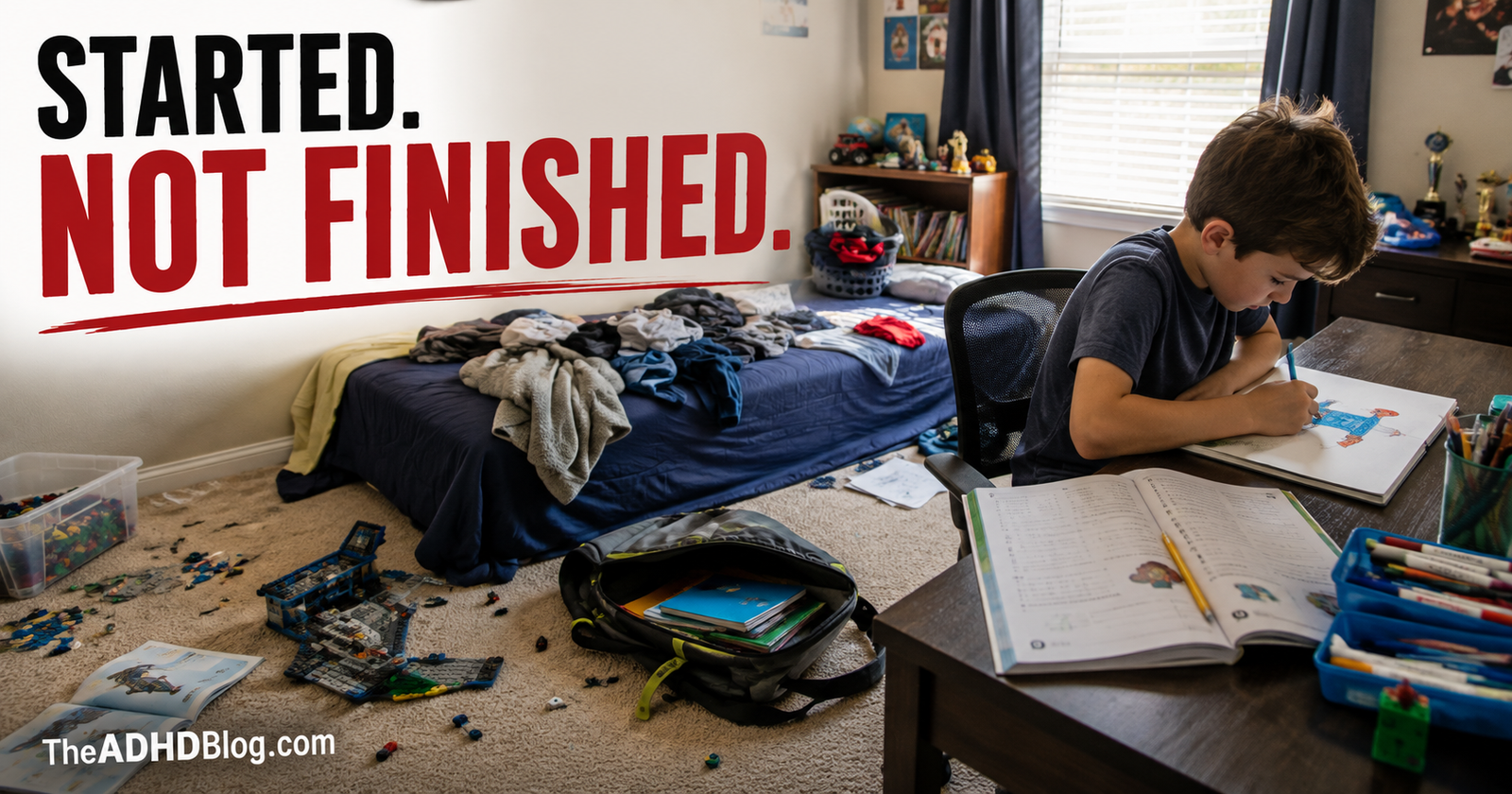
I can usually tell when my child has been busy.
The problem is that sometimes I can’t tell what they’ve actually finished.
There’s a LEGO project half-built on the floor, an art project sitting open on the table, clothes that made it halfway from the laundry basket to the dresser, and homework that was definitely started but somehow never made it past question four.
Then I find my child doing something completely different.
When I ask what happened to the original task, I might hear, “Oh yeah, I forgot,” or, “I’m going to finish it later.”
Sometimes they genuinely seem surprised that they never finished.
This can be one of the more confusing ADHD behaviors because getting started is supposed to be the hard part, right?
Sometimes it is. But starting and finishing are two different challenges.
The CDC actually includes failure to follow through and finish schoolwork, chores, or other duties among the inattentive symptoms clinicians consider when evaluating ADHD. It specifically describes losing focus or becoming sidetracked as examples of how that can happen.
That sounds a lot more like what I see in real life than simply saying my child is lazy or doesn’t care.
They may start with every intention of finishing.
Then somewhere between starting and done, the task loses them.
Starting a Task and Finishing It Require Different Skills
This distinction changed the way I looked at unfinished tasks.
Imagine the instruction is:
“Put your clean laundry away.”
Starting means picking up the basket and maybe putting the first few shirts in a drawer.
Finishing requires much more.
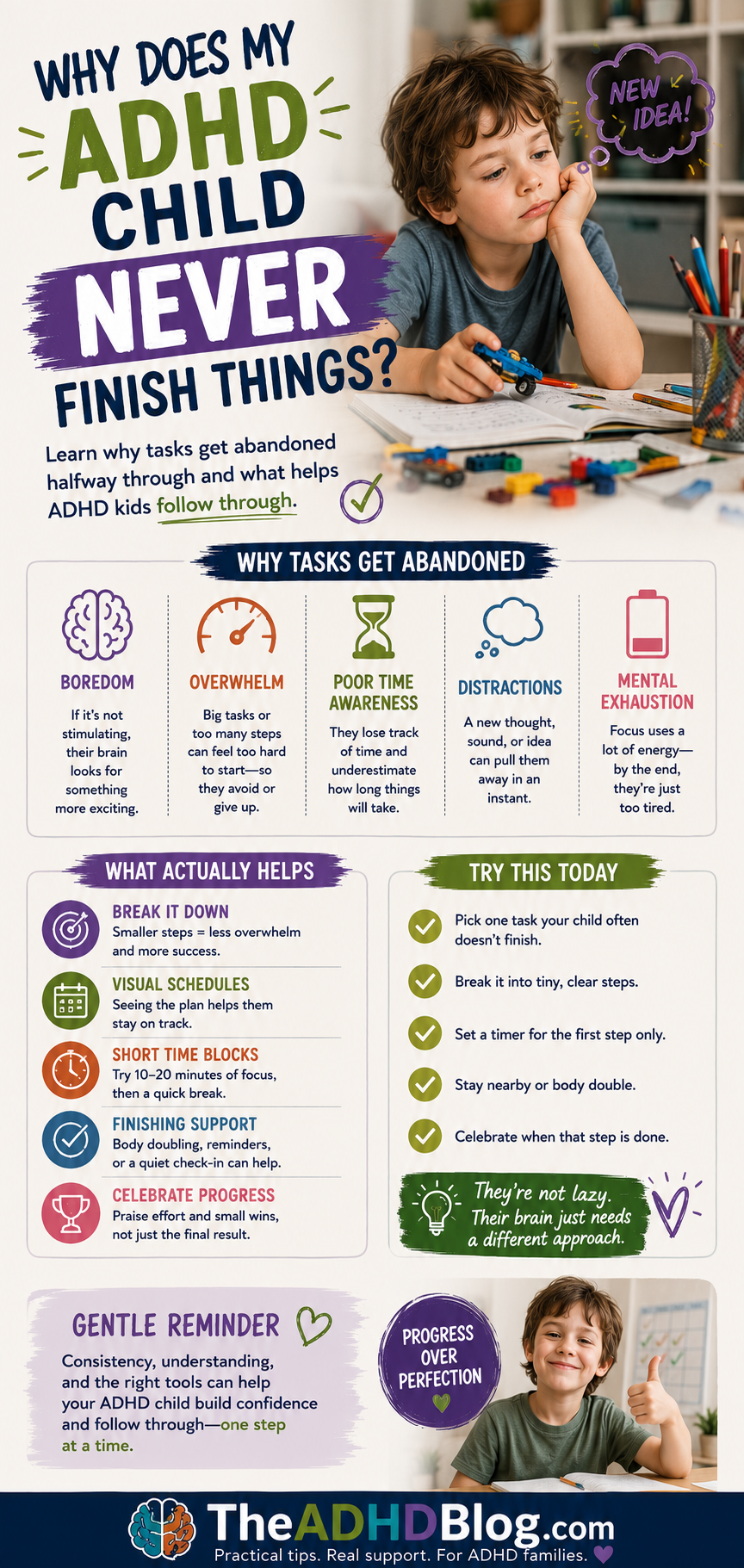
The child has to stay with a relatively boring task, resist whatever else catches their attention, remember what they’re trying to accomplish, decide where different items belong, continue even after the novelty wears off, and recognize when the entire job is actually complete. Those same demands become part of adult executive-function challenges, especially when work, finances, and household responsibilities replace childhood tasks.

That’s why I no longer automatically treat starting as proof that finishing should be easy.
The first 30 seconds might be the easiest part.
Staying with the task is where everything can unravel.

Sometimes the Task Simply Stops Holding Their Attention
I’ve watched this happen in real time.
My child begins cleaning.
A toy gets picked up.
Instead of putting the toy away, they remember how much fun it is.
Now they’re playing with it.
The original cleaning task hasn’t been deliberately rejected. It has essentially been replaced.
That’s an important difference.

Children with ADHD can have significant difficulty sustaining attention, particularly during tasks requiring longer periods of mental effort. The CDC also notes that children with ADHD may become deeply absorbed in activities that interest them and need additional help shifting attention. For children who benefit from tactile engagement, a hands-on focus aid can provide a hands-on focus aid while they work through less-interesting tasks.
That creates an interesting combination.
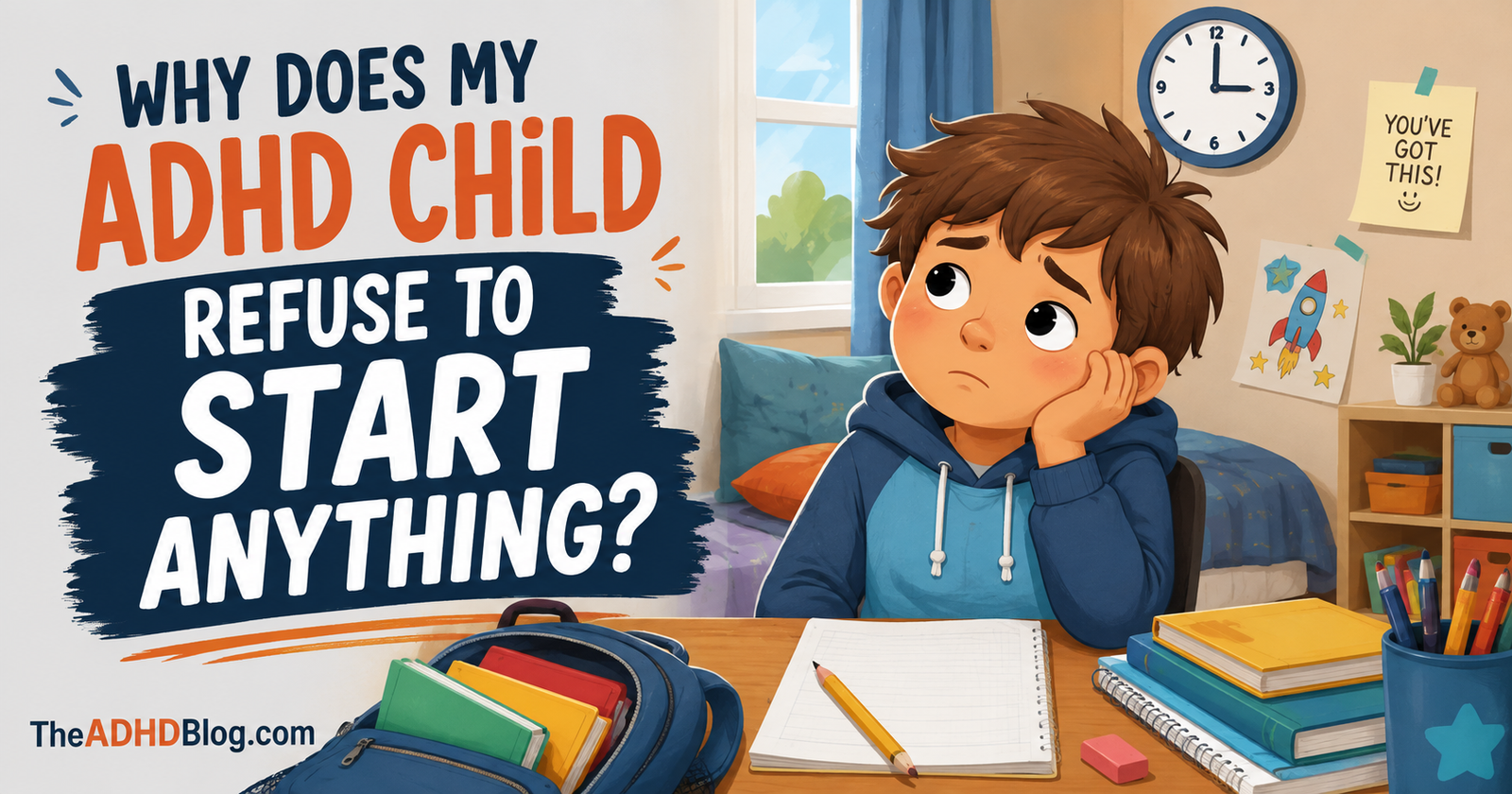
A boring task may lose their attention quickly, while the interesting thing they encounter along the way can grab it extremely well. That same contrast can help explain why boring tasks are hard to begin, even before attention has a chance to drift.
Suddenly the half-cleaned room makes a little more sense.

Distraction Doesn’t Always Look Like Looking Out the Window
When I hear distracted, I naturally picture a child staring at something unrelated instead of working.
But distraction can be much sneakier.
A child starts homework, notices their pencil needs sharpening, gets up to sharpen it, sees the dog, pets the dog, remembers they wanted to find a particular toy, and ten minutes later they’re upstairs.
The homework is still sitting open.
There wasn’t necessarily a conscious moment when the child decided:
“I’m not finishing my homework.”
The task simply disappeared behind everything that happened afterward.

That’s why minimizing unnecessary distractions can sometimes help. The CDC recommends reducing distractions and providing an appropriate workspace, while also noting that the ideal environment can differ from one child to another. For homework, a fidget pen for homework focus may be one practical option to consider alongside a less distracting workspace.
I don’t need to create a silent white room.
I need to figure out what helps this particular child stay connected to the task.
This Is Closely Connected to ADHD Forgetfulness
Sometimes the task isn’t abandoned because it became too difficult.
The child literally forgets they were doing it.
They start putting dishes away, leave the kitchen for something, and never return.
They begin getting dressed, walk into another room, and somehow start playing.
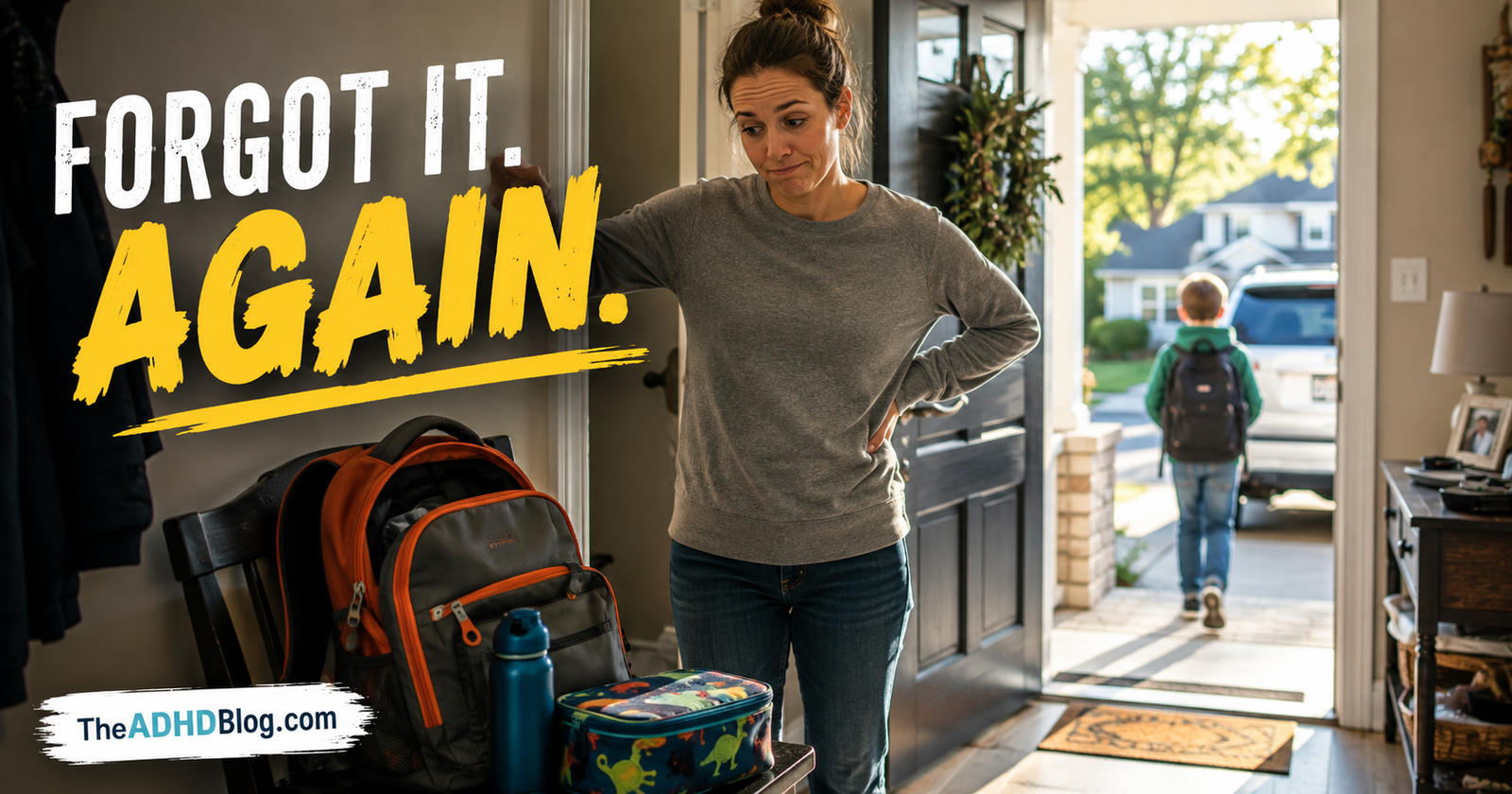
If this happens constantly, it fits closely with what we covered in why an ADHD child may forget everything you tell them.
The unfinished task and the forgotten instruction can be two versions of the same underlying difficulty.
The intention was there.
Keeping that intention active long enough to complete the job was the problem.
“Finish Your Room” May Not Have a Clear Finish Line
This is another thing I’ve learned to examine.
I know what I mean when I say:
“Finish cleaning your room.”
Does my child?
Maybe they picked up the clothes and genuinely thought they were finished.
I’m looking at the toys, trash, books, blankets, and desk.
We’re using completely different definitions of done.
That’s why vague tasks can create so much frustration.
Instead of telling my child to clean until the room somehow meets the picture inside my head, I can define the finish line.
“Dirty clothes in the hamper, toys in the bins, and trash in the trash can. Then you’re done.”
Now there’s an actual destination.
Big Tasks Can Become Overwhelming Halfway Through
Sometimes the child starts enthusiastically and then realizes the task is much larger than expected.
Cleaning a bedroom is a perfect example. For a more concrete way to break that chore into steps, an ADHD cleaning checklist may help.
At first, they pick up a few things.
Then they look around.
There’s still stuff everywhere.
Suddenly the task feels endless.
The CDC recommends breaking complicated tasks into simpler, shorter steps and using breaks during longer tasks when appropriate.
Instead of:
“Finish your entire room.”
I might make the first finish line:
“Get every piece of dirty clothing into the hamper.”
Then:
“Now let’s get everything off the bed.”
We’re creating small completions inside a larger job.
That matters because finishing something feels very different from endlessly working on something.


ADHD Chores Can Turn Into a Trail of Half-Done Jobs
Chores are where this becomes painfully obvious.
I ask for three things.
The trash bag gets removed from the can but never makes it outside. The dishwasher gets half unloaded. The laundry gets moved from the basket to the bed, where it now lives for the next two days.
Technically, my child did start every chore.
That’s not particularly useful when none of them are complete.

This is why our guide to ADHD chores for kids and what actually works focuses so much on clear expectations and manageable tasks.
I’ve found that one completely finished chore is often more useful than five partially started ones.
I Try Not to Give Another Job Before the First One Is Finished
This one is surprisingly easy for parents to cause ourselves.
My child is putting laundry away and I walk by.
“Oh, when you’re done, take that cup downstairs.”
Then I notice something else.
“And bring your shoes with you.”
Then:
“Actually, can you feed the dog too?”
I’ve now introduced three new destinations while the original task is still happening.
For a child who already struggles to hold onto a task, that’s not ideal.
Whenever possible, I try to protect the task that’s currently underway.
Finish this first.
Then we move to the next thing.

This Is Also Why Telling Everything 10 Times Becomes So Common
If the child starts but doesn’t finish, I naturally remind them.
“Finish your laundry.”
Then I find them doing something else.
“Hey, you still need to finish your laundry.”
Twenty minutes later:
“What happened to the laundry?”
Before long, I’ve repeated the same instruction over and over.
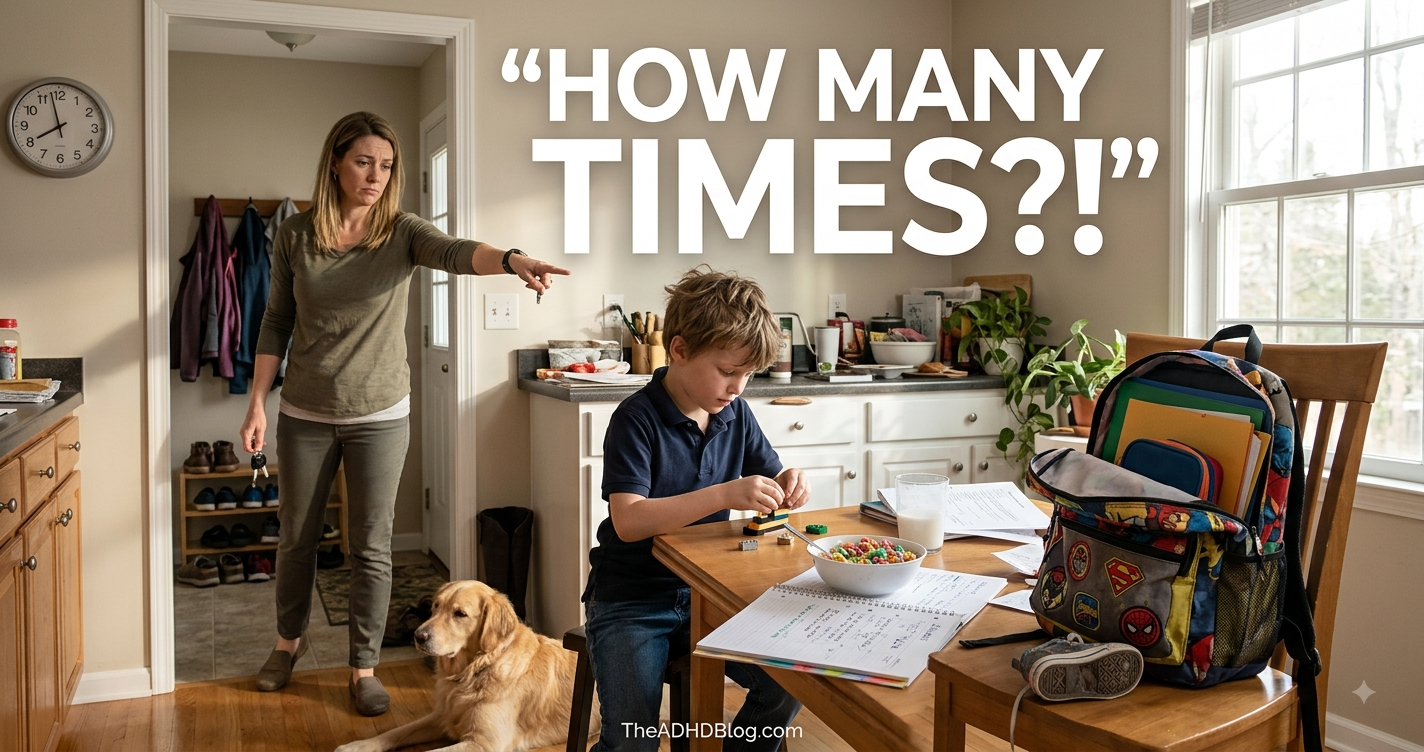
That’s why this connects directly with why an ADHD child may need to be told everything 10 times.
The answer isn’t always giving a more forceful reminder.
Sometimes I need to figure out where the task keeps breaking down.
Watch the Exact Point Where Your Child Stops
This is something I’d encourage parents to actually observe.
Don’t only notice that the task wasn’t finished.
Notice where it stopped.
Maybe your child can work independently for about five minutes before wandering away.
Maybe they stop whenever they encounter a decision.
Maybe they leave when the task becomes difficult.
Maybe they get distracted whenever they have to move into another room.
Maybe they consistently abandon tasks after interruptions.
Maybe they do great until they’re asked to complete the boring cleanup portion.
Those patterns are incredibly useful.
Instead of trying to solve:
My child never finishes anything
I’m solving:
My child loses the task whenever they leave the room.
That’s much more specific.
And specific problems are easier to work with.

Some Kids Love Starting Because Starting Is the Interesting Part
I’ve seen children get extremely excited about a new project.
They have plans.
They’re gathering supplies.
They’re talking about what they’re going to build.
They may work intensely for a while.
Then tomorrow the project is sitting untouched.
A new idea has replaced it.
I don’t necessarily want to crush that enthusiasm. Starting projects, exploring interests, and being creative are good things.
But I also want to teach the less exciting part:
completion.
Sometimes that means making projects smaller.
Instead of starting something that requires three weeks of sustained attention, maybe we choose something that can realistically be completed this afternoon.
Experiencing completion is a skill too.
The Last 10 Percent Can Be the Hardest Part
This happens with adults too.
The exciting work is finished.
Now comes cleanup.
Putting supplies away.
Checking the answers.
Packing everything back into the backpack.
Turning the assignment in.
Those final steps aren’t exciting, but they’re often what determines whether the task actually counts as complete.
Homework is a great example.
A child can do every math problem correctly and still fail to turn in the paper.
HealthyChildren points out that homework success involves an entire chain of steps, including knowing the assignments, having the right materials, completing the work, checking that it is done, and making sure completed work actually gets turned in.
That’s why I don’t define homework as:
Did you answer the questions?
I define it as:
Is the finished assignment where it needs to be for tomorrow?
Homework Can Reveal Every Weak Point in Follow-Through
Homework may require more independent task management than almost anything else a child does at home.
Get the assignment.
Bring the correct materials home.
Remember to start.
Stay focused.
Complete multiple sections.
Check the work.
Put everything away.
Bring it back.
Turn it in.
There are a lot of places for the chain to break.

Our ADHD homework tips for parents go deeper into creating a setup that makes those steps easier.
The American Academy of Pediatrics also recommends looking systematically at each stage of homework when a child with ADHD is struggling, rather than treating “homework” as one single problem.
That’s exactly how I think about unfinished tasks in general.
Break the process apart and find the weak spot.
Try Making “Done” Visible
This is one of my favorite strategies because it removes ambiguity.
If my child has three responsibilities after school, put three boxes on a checklist.
When each one is finished, it gets checked.
Now the child can see:
Two finished. One left.
That’s much clearer than having several tasks floating around mentally.
HealthyChildren recommends written lists of chores and daily tasks as useful tools for helping children with ADHD track what they need to accomplish.
I especially like checklists for recurring tasks because eventually I don’t have to keep inventing the instructions.
The list already knows what “done” looks like.
Don’t Make the Checklist Ridiculous
I could easily create a checklist with 27 items.
That’s probably not helping.
If my child already becomes overwhelmed by tasks, I don’t want the organizational system itself to become another overwhelming task.
Start small.
Maybe the after-school list has three things.
Backpack away.
Lunchbox emptied.
Homework folder on the table.
Once that works reliably, we can add complexity if we need it.
The goal is successful independence, not creating the world’s most impressive family management system.
Timers Can Help With Tasks That Feel Endless
Sometimes the resistance comes from believing the task will take forever.
“Clean your room” sounds enormous.
But:
“Let’s see what you can finish in ten focused minutes”
feels different.
I don’t use a timer as a threat.
I’m using it to make the workload feel finite.
For some kids, knowing there’s a defined work period followed by a break can make it easier to stay with a task.
The CDC recommends starting longer tasks early, breaking them into shorter steps, and using breaks when needed to limit stress.
A timer is simply one way I can make those boundaries visible.
Be Careful About Interrupting Hyperfocus Too
There’s an interesting flip side to all of this.
Sometimes my child isn’t bouncing between activities.
They’re so absorbed in one thing that everything else disappears.
Then I need them to stop and do something else.
That becomes a transition problem.
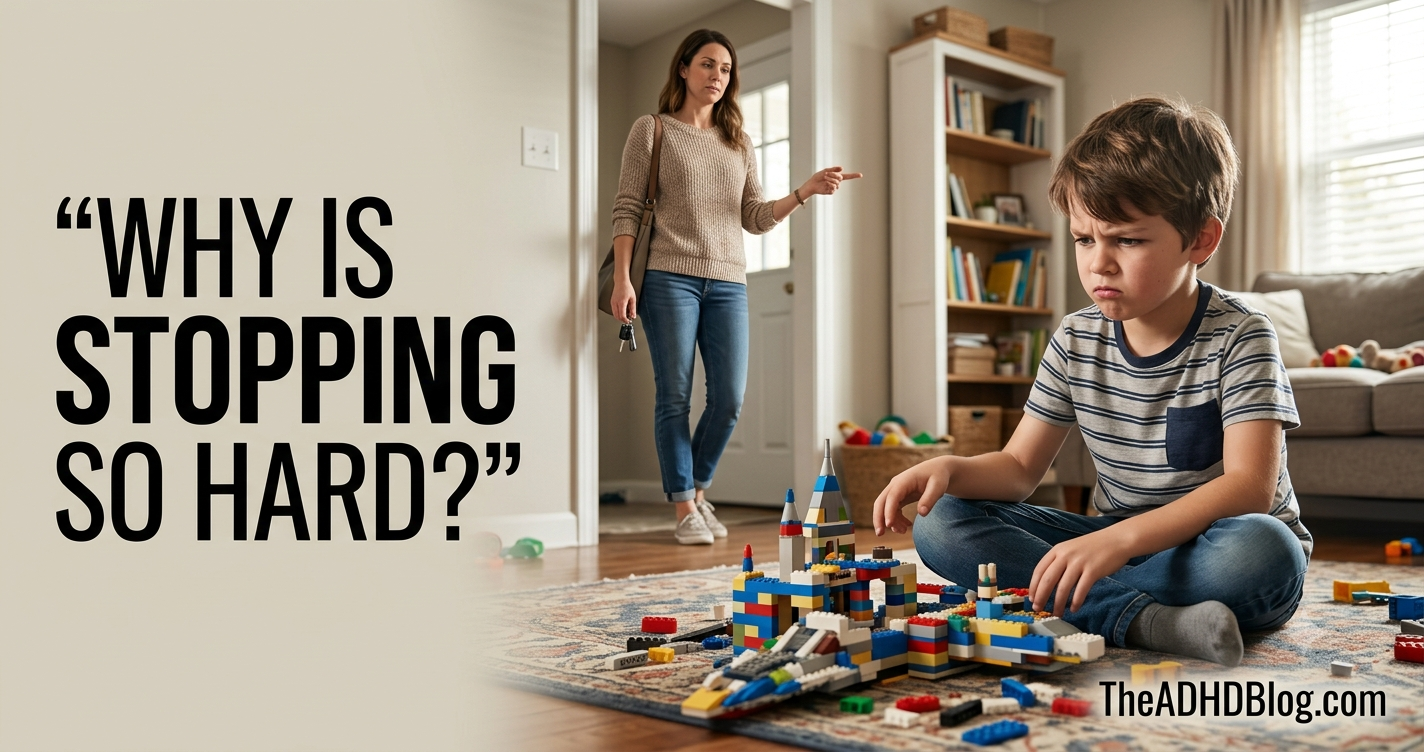
Our article on why transitions are so hard for kids with ADHD covers that situation in detail.
ADHD can sometimes look contradictory from the outside.
How can the same child abandon homework after four minutes but spend an hour completely absorbed in building something?
Because the problem isn’t simply:
Can this child pay attention?
The bigger issue can involve regulating where attention goes and shifting or sustaining it according to what the situation requires.
Motivation Matters More Than Parents Sometimes Want It To
This is where ADHD can be especially frustrating.
The child finishes things they care about.
The boring things are abandoned.
That can look like proof they’re choosing the entire problem.
But motivation affects everybody’s ability to persist, and boring, repetitive, effortful tasks can be particularly difficult for children struggling with ADHD symptoms.
That doesn’t mean I remove every boring task from life.
Nobody gets that deal.
Instead, I look for ways to make completion more immediate and visible.
Maybe the task is shorter.
Maybe there’s a checklist.
Maybe I provide positive feedback when it’s completed.
Maybe a larger job gets divided into sections.
We’re not waiting for the child to magically become fascinated by unloading a dishwasher.
We’re creating enough structure to help them finish it anyway.
Praise Finishing More Than Enthusiastic Starting
This is something I’ve intentionally changed.
Starting gets lots of natural excitement.
“I’m building this!”
“I’m going to make this!”
“Look what I’m doing!”
Finishing can be quieter.
So I want to notice it.
“You stayed with that until the whole thing was done.”
That’s specific praise.
Or:
“You got distracted, came back, and finished anyway.”
I actually love that one because it doesn’t pretend successful ADHD management means never getting distracted.
The skill is returning to the task.
The CDC recommends realistic goals and positive reinforcement for children with ADHD, with an emphasis on small steps.
Finishing one manageable task is exactly the kind of small success I want to build on.
Teach “Come Back to It” as a Skill
I don’t expect my child to become distraction-proof.
Neither am I.
The more realistic skill is recognizing:
“I got off track.”
Then returning.
If I find my child halfway into something unrelated, I don’t always need a lecture.
Sometimes I can simply say:
“What were you working on before this?”
That forces a little mental rewind.
Maybe they remember:
“Oh, laundry.”
Then:
“Right. Finish that first, then come back to this.”
We’re practicing recovery from distraction rather than treating every distraction like a disciplinary crisis.
Try Not to Turn Unfinished Tasks Into a Moral Problem
This is important because the language can get harsh quickly.
Lazy.
Careless.
Unmotivated.
Doesn’t care.
Never finishes anything.
Those descriptions don’t tell us where the process failed.

And if the child already struggles with taking corrections very personally, hearing that they’re lazy or incapable can quickly become part of how they see themselves.
I want to describe what actually happened.
“You started putting the clothes away, but you got distracted before the basket was empty.”
Now we have a problem we can solve.
That’s much different from:
“You never finish anything.”
Don’t Confuse Support With Doing Everything for Them
There’s a balance here.
If I always finish every abandoned task myself, my child isn’t learning much.
If they put away half the laundry and disappear, I don’t necessarily need to quietly finish the other half.
I can bring them back.
“The basket isn’t empty yet. Finish that, then you’re done.”
Support might mean reducing the task, giving a clear finish line, helping them restart, or using a checklist.
Support doesn’t have to mean taking over.
HealthyChildren describes routines, lists, and structure as a kind of scaffolding that can gradually be removed as a child becomes more capable of managing tasks independently.
That’s exactly the balance I want.
Enough support to succeed, with a long-term plan to need less support.
Sometimes a Body Double Helps
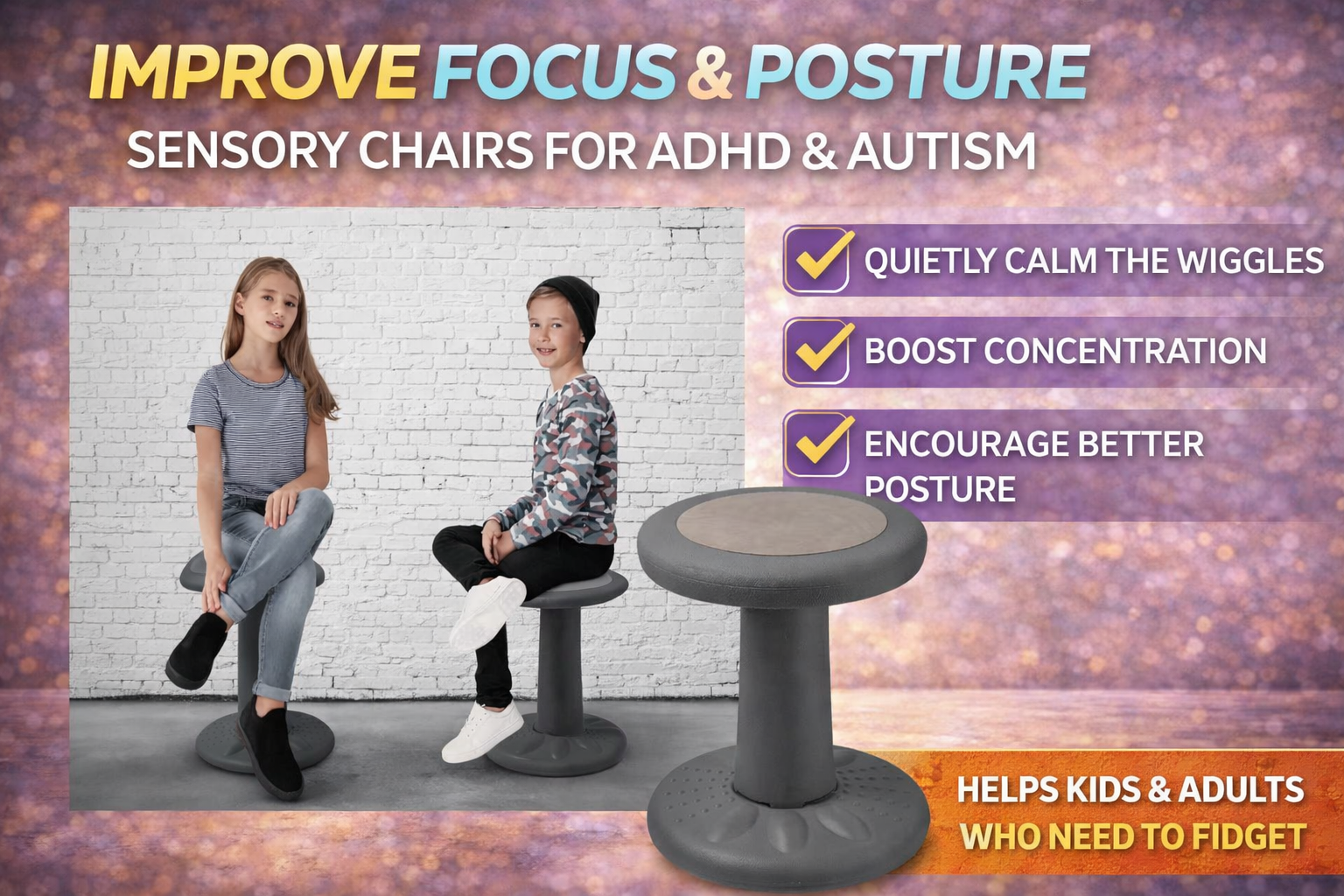
Some children seem to stay on task much better when another person is simply nearby. For children who focus better with some movement, an active wobble chair may be another workspace option to consider.
I don’t necessarily have to do the chore for them.
Maybe I’m folding my own laundry while they put theirs away.
Maybe I’m working at the kitchen table while they do homework.
Maybe we’re both cleaning different things in the same room.
That nearby presence can make it easier for some children to stay anchored to what they’re doing.
I don’t want this to become permanent supervision of every task, but it can be a useful bridge while we’re developing stronger routines and independent follow-through.
Build Completion Into the Routine
The more predictable a task becomes, the less mental effort it may require to remember every step from scratch.
After homework, the folder goes in the backpack.
After dinner, the plate goes to the sink.
After getting undressed, clothes go in the hamper.
After finishing an activity, supplies get put away.
HealthyChildren emphasizes that routines and written task lists can make daily life more manageable for children with ADHD and help build self-management over time.
That’s why I like attaching the final step to the activity itself.
The task isn’t finished until the cleanup or put-away step happens.
School May Be Seeing the Same Problem
A child who starts but doesn’t finish things at home may be doing something very similar in class.
Maybe assignments are partially completed.
Maybe work is rushed at the end because the child lost time earlier.
Maybe projects get started but deadlines are missed.
Maybe completed work doesn’t get turned in.
If that’s happening, I want to communicate with the teacher rather than treating home and school as separate worlds.

School-based ADHD supports can include organizational training, shorter or divided assignments, positive feedback, fewer distractions, and tools that reduce how much the student has to keep track of. For students who focus better with gentle movement, a discreet movement support may reduce distraction without requiring them to sit completely still.
Sometimes the teacher has already identified exactly where the child gets stuck.
That’s useful information for everybody.
What If My Child Never Finishes Anything Unless I Stand There?
That’s a sign I’d look closely at the amount of independence we’re expecting.
Maybe the child can currently handle a five-minute task independently but not a 30-minute one.
That’s okay.
We start where they are.
I might stay nearby for the first few attempts, then step away for part of the task, then check at the finish line.
Over time, I want to stretch the amount of independent work.
What I don’t want is to suddenly remove every support and then conclude the child is incapable because everything falls apart.
Scaffolding works because we gradually remove it.
What If My Child Gets Angry When I Tell Them to Finish?
This is where executive-function problems can collide with emotional regulation.
The child has already mentally moved on.
Then I tell them:
“You’re not finished.”
Now they’re frustrated because, in their mind, the old task was over.
That frustration can quickly become arguing, crying, or anger.
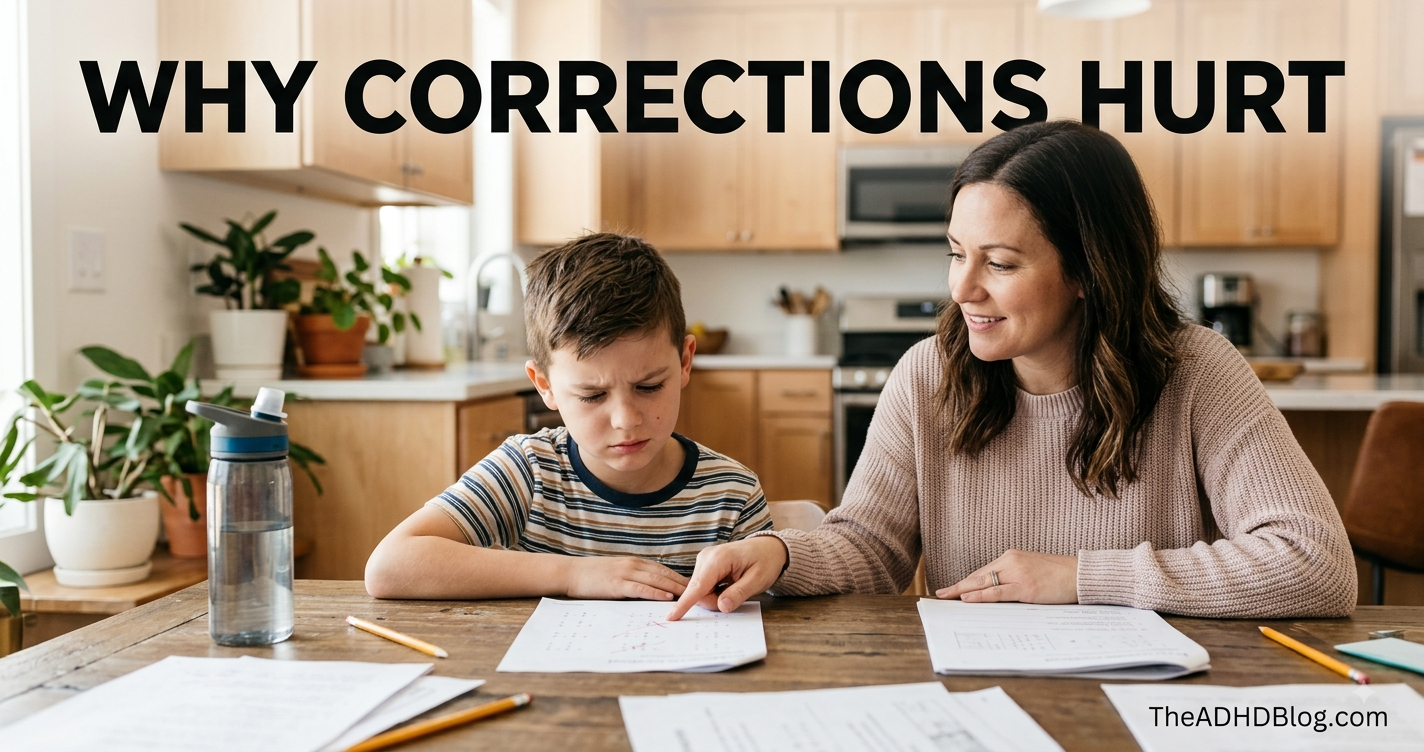
If corrections themselves regularly trigger a large reaction, our guide on why an ADHD child gets so upset when corrected explains that pattern in much more detail.
I can keep the expectation without turning it into a character judgment.
“I know you want to do this now. The laundry still has five things left. Finish those, then you’re done.”
Short. Specific. Finish line.
When Unfinished Tasks Become a Full Meltdown
Sometimes the task has gone far beyond ordinary resistance.
The child is overwhelmed, crying, yelling, or completely unable to continue productively.
At that point, another 15-minute lecture about responsibility isn’t likely to improve task completion.
Depending on the situation, we may need to regulate first and return to the issue afterward.

That’s where our guides on how to calm a child during an ADHD meltdown and what to do after an ADHD meltdown fit into the bigger picture.
The goal isn’t using ADHD to escape every difficult task.
It’s recognizing when the child’s ability to complete the task has been temporarily buried under a much bigger emotional reaction.
Behavior Therapy Can Help With Follow-Through
If unfinished tasks are creating major problems at home, parents don’t have to figure everything out through trial and error.
Parent training in behavior management is an established ADHD treatment approach. The CDC says it can help improve behavior, self-control, and self-esteem, while teaching parents strategies involving positive reinforcement, structure, and consistent discipline.
That’s worth emphasizing because “behavior therapy” doesn’t simply mean sending a child into a room to talk about why they didn’t finish their chores.
Parent training can give the adults concrete strategies for changing what happens around the behavior too.
Medication Questions Belong With the Child’s Healthcare Provider
If your child is already being treated for ADHD and task completion remains a major problem, that’s useful information to bring to their clinician.
I wouldn’t change medication, dosage, or timing based on something I read online.
ADHD treatment is individualized, and the CDC notes that healthcare providers may need to monitor and adjust treatment to find an appropriate balance of benefits and side effects.
What I can bring to an appointment is useful observation.
“They start homework but consistently lose focus after about ten minutes.”
That’s much more informative than:
“The medicine doesn’t work.”
Specific patterns help professionals understand what’s actually happening.
Not Finishing Things Isn’t Automatically ADHD
I don’t want to turn every unfinished LEGO project into a symptom.
Kids abandon things.
Adults abandon things.
Sometimes something simply isn’t interesting anymore.
Sometimes a task is too hard.
Sometimes instructions weren’t clear.
Sometimes the child doesn’t understand the material.
Sometimes they’re tired, anxious, stressed, or dealing with something unrelated to ADHD.
The CDC notes that conditions including anxiety, depression, sleep problems, and some learning disabilities can produce symptoms that overlap with ADHD.
That’s why I look at the overall pattern.
Is this happening constantly, across different areas of life, and interfering with functioning?
That’s different from a kid who got bored with one puzzle.
I Want to Teach My Child How to Finish, Not Just Tell Them to Finish
That’s the biggest difference in how I approach this now.
“Finish what you started” sounds like perfectly reasonable advice.
But if my child consistently can’t do that, repeating the phrase doesn’t teach the missing skill.
I want them to learn how to define what done looks like, break a large job into smaller finish lines, reduce distractions when necessary, notice when they’ve gotten off track, return to the task, use checklists or routines when their memory isn’t enough, and clean up the final 10 percent that isn’t particularly interesting.
Those are real skills.
And over time, I want to need less involvement.
Maybe today I have to stand nearby and say:
“You got distracted. What’s left?”
Later, perhaps the checklist does that job.
Eventually, maybe my child catches themselves halfway into something else and thinks:
“Wait. I wasn’t finished.”
That’s the progress I’m looking for.
Because a child who starts things but never finishes them doesn’t necessarily need another person following behind saying “finish it” for the next ten years.
They need opportunities to practice the much more valuable skill of getting themselves from started all the way to done.
About the Author: Emily Parker
Emily Parker writes for TheADHDBlog.com about the everyday challenges families face while raising children with ADHD, including executive function, emotional regulation, routines, school struggles, transitions, and behavior at home. Her work combines practical family strategies with guidance from established pediatric and ADHD resources, helping parents understand what may be happening beneath frustrating behaviors and build skills that support greater independence.