
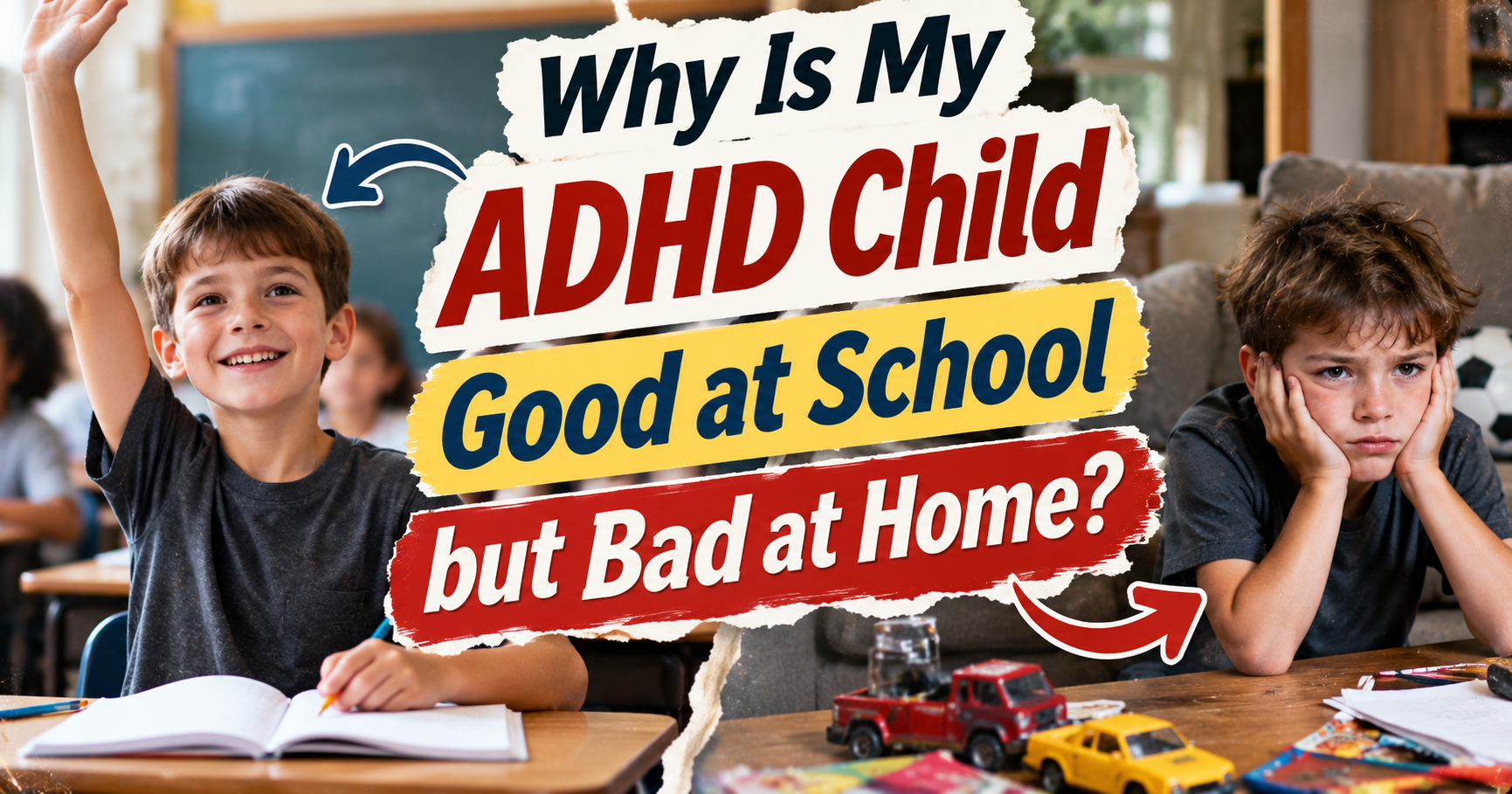
Have you ever wondered why an ADHD child can be good at school but bad at home? Maybe the teacher says your child had a pretty decent day, but the minute they get home, everything seems to fall apart. Suddenly, simple directions turn into arguments, little disappointments feel enormous, and you’re wondering what happened between the classroom and your front door.
As parents raising a 7-year-old with ADHD, my wife and I understand how exhausting those emotional ups and downs can be.
Our son’s ADHD is pretty severe compared to what I deal with as an adult. He struggles with focusing at school, remembering instructions, managing frustration, and sometimes even feeling comfortable being alone. He’s also been through numerous ADHD medication trials and sees a mental health doctor.
So I want to make something clear right away. Our son doesn’t magically hold everything together at school and save all his struggles for home. School is difficult for him, too.
But we’ve learned that some children with ADHD manage to hold themselves together better in structured environments, only to become overwhelmed once they’re home.
And understanding why that happens can change how we respond as parents.
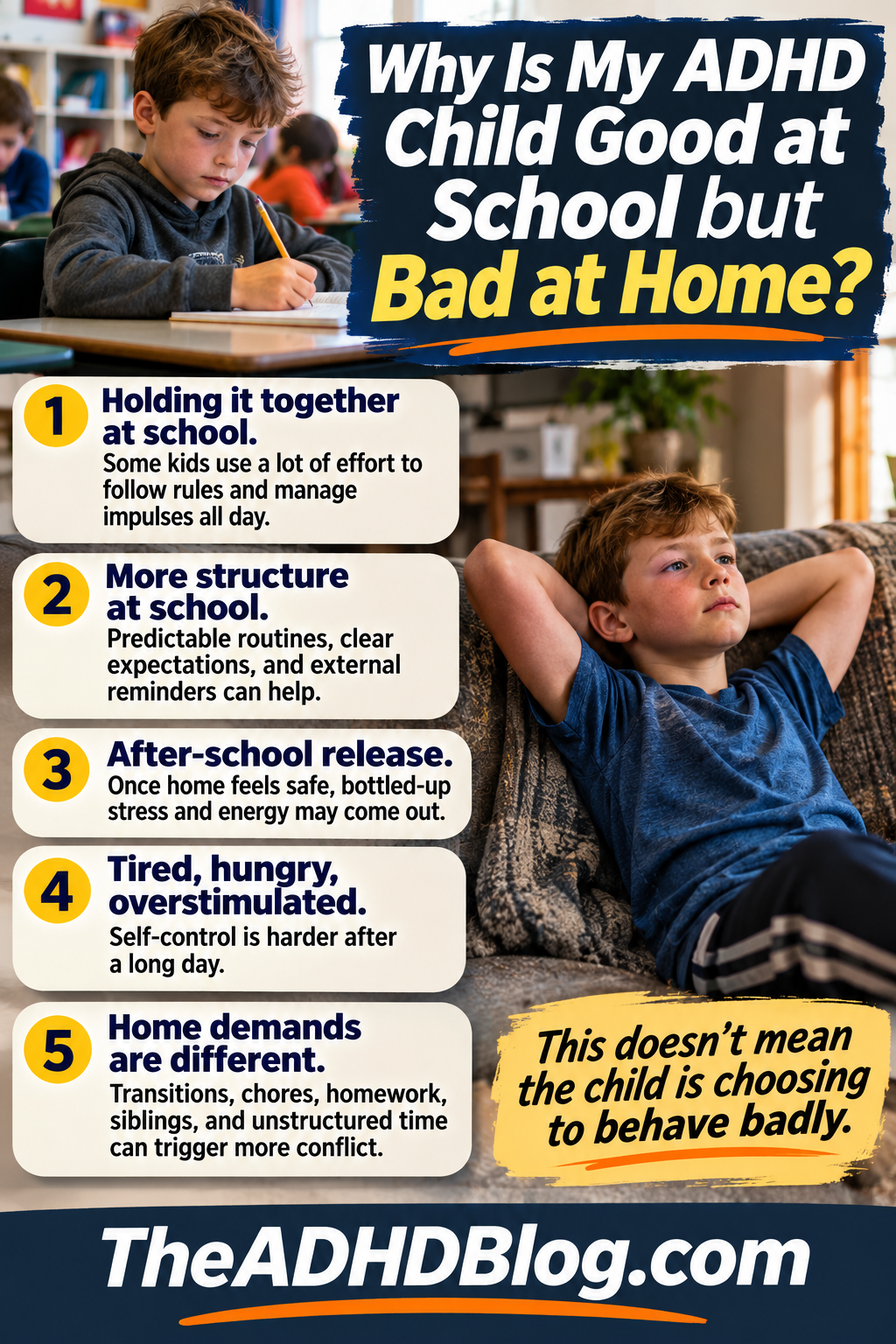
Why Is My ADHD Child Good at School but Bad at Home?
One of the most confusing things about raising a child with ADHD is how differently they can behave depending on where they are.
A child might follow directions at school, participate in activities, and avoid major behavioral problems, only to come home and argue about putting their shoes away.
It’s enough to make you wonder whether they’re doing it on purpose.
But there are several reasons this can happen, and none of them automatically mean your child is deliberately saving their worst behavior for you.
School and Home Expect Different Things
Think about how much structure exists in a typical elementary school classroom.
There’s a schedule. The teacher tells students when to work, when to eat, when to play, and when to move to the next activity.
Many classrooms also have visual reminders, predictable rules, and classmates following the same routine.
At home, things are different.
There might be dinner cooking, a younger sibling playing, television noise, homework waiting, and parents trying to get everything done before bedtime.
For a child who struggles with attention and emotional regulation, switching between those environments can be difficult.
Why Does My Child Fall Apart Around Us?
Home is often where children feel most comfortable expressing their emotions.
That doesn’t mean every meltdown is caused by feeling safe, and it certainly doesn’t mean parents should ignore difficult behavior.
It simply means children may respond differently when they’re no longer trying to meet the expectations of a classroom.
A child who spent the day trying to sit still, listen, remember instructions, and control impulses might have very little patience left by dinner.
And sometimes the smallest request is enough to push them over the edge.
What We Have to Remember as Parents
My wife and I have our own experiences with ADHD, although they look different from our son’s.
I struggled much more with ADHD as a child than I do today. My current difficulties are largely related to anxiety and depression, which are fairly well managed with treatment.
My wife’s ADHD is milder. She stays busy handling work, household responsibilities, and everything else that comes with raising a family. Sometimes she gets distracted or forgets what she was saying halfway through a sentence.
But our son faces challenges that go well beyond ordinary forgetfulness.
That’s why we’ve had to learn that a child’s behavior is only part of the story. We also need to understand what happened before that behavior started.


What Is After School Restraint Collapse in Kids With ADHD?
There’s a term you might come across while researching why your ADHD child’s behavior gets worse after school.
It’s called after-school restraint collapse.
It describes a pattern where children become emotionally overwhelmed after spending much of the day managing expectations, following rules, and controlling their behavior.
It’s a descriptive term, not a separate medical diagnosis.
And while it isn’t exclusive to ADHD, children who struggle with attention, impulse control, anxiety, or emotional regulation may have a particularly difficult time with the transition home.
Think About Everything Your Child Does at School
For an adult, sitting through a meeting that lasts an hour can be frustrating.
Now imagine being seven years old and spending much of your day doing things that require the very skills your brain struggles to manage.
A child with ADHD may spend the school day trying to:
- Pay attention: Listen while the teacher explains something, even when other students are talking or moving around.
- Remember instructions: Keep track of what they’re supposed to do next without forgetting halfway through.
- Control impulses: Wait their turn, avoid interrupting, and resist acting on every thought.
- Handle frustration: Keep working when something feels difficult or confusing.
- Manage transitions: Stop an enjoyable activity and immediately switch to something less interesting.
- Navigate friendships: Understand social expectations, share, cooperate, and handle disagreements.
That’s a lot for any young child.
For a child with ADHD, some of those tasks can require considerably more effort.
What Happens When They Get Home?
Picture a child who has spent the day trying hard to follow classroom expectations.
They finally get home.
Their backpack hits the floor. They’re hungry, tired, and ready to do something they actually enjoy.
Then a parent says, “Before you play, please put your backpack away and wash your hands.”
And suddenly, there’s yelling.
The request itself wasn’t unreasonable. But it may have arrived when the child had very little capacity left to handle another demand.
This is where it helps to look beyond the immediate argument.
Was the child hungry?
Did they sleep poorly?
Did something upsetting happen at school?
Have they been dealing with a difficult medication adjustment?
Are they overwhelmed by noise or expectations?
Sometimes the problem isn’t the backpack at all.
Does Every Child With ADHD Experience This?
No.
Some children struggle more at school. Others have more trouble at home. Many have significant challenges in both places.
Our son’s experience is a reminder that ADHD doesn’t follow one predictable pattern.
His attention difficulties and emotional struggles affect multiple parts of his life, which is one reason we’ve continued working with his mental health doctor and exploring different treatment options.

I’ve shared more about what living with ADHD really looks like in our home because the challenges go far beyond what people usually picture when they hear the word ADHD.
Why Does My ADHD Child Get So Angry After School?
One of the hardest parts of ADHD parenting is watching a small problem turn into a very big emotional reaction.
A child might get upset because their favorite snack isn’t available, because a toy isn’t where they expected it, or because someone asks them to stop playing.
To us, those things might seem minor.
To a child who’s already overwhelmed, they might feel enormous.
ADHD Can Make Emotional Regulation Harder
Emotional regulation is the ability to recognize feelings and respond to them in a manageable way.
Children are still learning that skill, whether they have ADHD or not.
But ADHD can make it harder to pause before reacting, shift attention away from something upsetting, or recover from frustration.
That’s especially challenging when a child is already tired.
Our son can become upset fairly easily, and it’s one of the difficulties we’ve been trying to help him manage.
Sometimes it’s tempting to focus entirely on what he’s doing wrong.
But we also have to ask ourselves whether he has the skills and support he needs to handle that particular situation.
Why More Talking Isn’t Always Helpful
Imagine your child is already crying because something didn’t go their way.
You begin explaining why they need to calm down, why their reaction isn’t appropriate, and what they should have done differently.
Meanwhile, they’re getting more upset.
Sound familiar?
When children are highly distressed, long explanations can be difficult for them to process.
A better approach is often to keep your response short and calm.
For example:
- Acknowledge the feeling. “I can see you’re really frustrated.”
- Set a clear boundary. “It’s okay to be upset, but I can’t let you hit.”
- Reduce unnecessary demands. Save the long explanation until your child is calmer.
- Offer appropriate support. Some children want a parent nearby. Others prefer a little space while remaining supervised.
- Talk afterward. Once things settle, discuss what happened and what might help next time.
None of these steps guarantees that a meltdown will stop immediately.
But they give parents a more constructive way to respond than getting pulled into an argument.
What If the Anger Seems Worse Than Normal?
This is particularly important for families whose children take ADHD medication.
My wife and I have spent more than a year navigating medication changes for our son. Some medications provided little improvement, while others were associated with emotional side effects that concerned us.
We’ve documented those experiences in our child’s ADHD medication journey and real-life case study.
If your child’s behavior suddenly changes, especially after starting a medication or changing the dose, contact their prescribing clinician.
Don’t automatically assume every new emotional problem is simply part of ADHD.
Sleep problems, anxiety, learning difficulties, medication effects, and other conditions can contribute to difficult behavior, too.
How Can We Make After School Easier for a Child With ADHD?
Sometimes the most helpful thing we can do is stop expecting our children to immediately jump into another list of responsibilities when they walk through the door.
Think about how you feel after an exhausting workday.
You get home, and before you’ve even taken your shoes off, someone starts asking questions and handing you things to do.
Not exactly relaxing, is it?
Now imagine being seven and having difficulty controlling your attention and emotions in the first place.
That’s why an after-school transition routine is worth trying.
Start With a Short Decompression Period
Instead of immediately jumping into homework, chores, or questions about the school day, consider giving your child a little time to settle.
That might involve:
- Having a snack and something to drink.
- Spending time outdoors or moving around.
- Playing quietly with a favorite toy.
- Sitting with a parent without being asked a dozen questions.
- Having a few minutes of quiet before starting another activity.
Some children benefit from movement. Others need less stimulation.
The important part is noticing what your particular child responds to.
Don’t Turn Every Afternoon Into Another School Day
School already requires a lot of structured attention.
Once children get home, they still have responsibilities, but those responsibilities don’t necessarily have to begin immediately.
For example, rather than saying, “Get your homework done before you do anything else,” you might try:
“Let’s get something to eat, take a little break, and then we’ll work on your homework together.”
That small change gives your child a clearer transition.
It also creates an opportunity to reconnect before asking them to focus again.
We cover additional strategies in our guide to helping a child with ADHD focus at home without constant battles.
Give One Direction at a Time
This is especially important for children who struggle with working memory.
Working memory helps us hold information in our minds long enough to use it.
For example, telling a child to put away their shoes, wash their hands, unpack their lunchbox, and start homework requires them to remember several instructions.
A child with ADHD might begin the first task and completely forget the others.
Instead, try one instruction.
“Please put your shoes by the door.”
Once that’s finished, give the next instruction.
It’s simple, but simple is often exactly what an overwhelmed child needs.
Pay Attention to the Timing of Medication
For children taking ADHD medication, the timing of symptoms can be useful information for their prescriber.
Some children experience increased irritability or difficulty regulating their behavior as certain stimulant medications wear off. This is sometimes called medication rebound.
However, not every afternoon meltdown is rebound, and parents shouldn’t assume medication is responsible without discussing the pattern with their child’s clinician.
A simple observation log can help:
- What time did your child take their medication?
- What time did the difficult behavior begin?
- Had they eaten and slept normally?
- Was there an unusual school or family event?
- Did the same pattern happen on other days?
Those details can be much more useful at a medical appointment than trying to remember an entire week of difficult afternoons.
And as parents who’ve been through multiple medication trials, we know how quickly those little details can become hard to remember.