
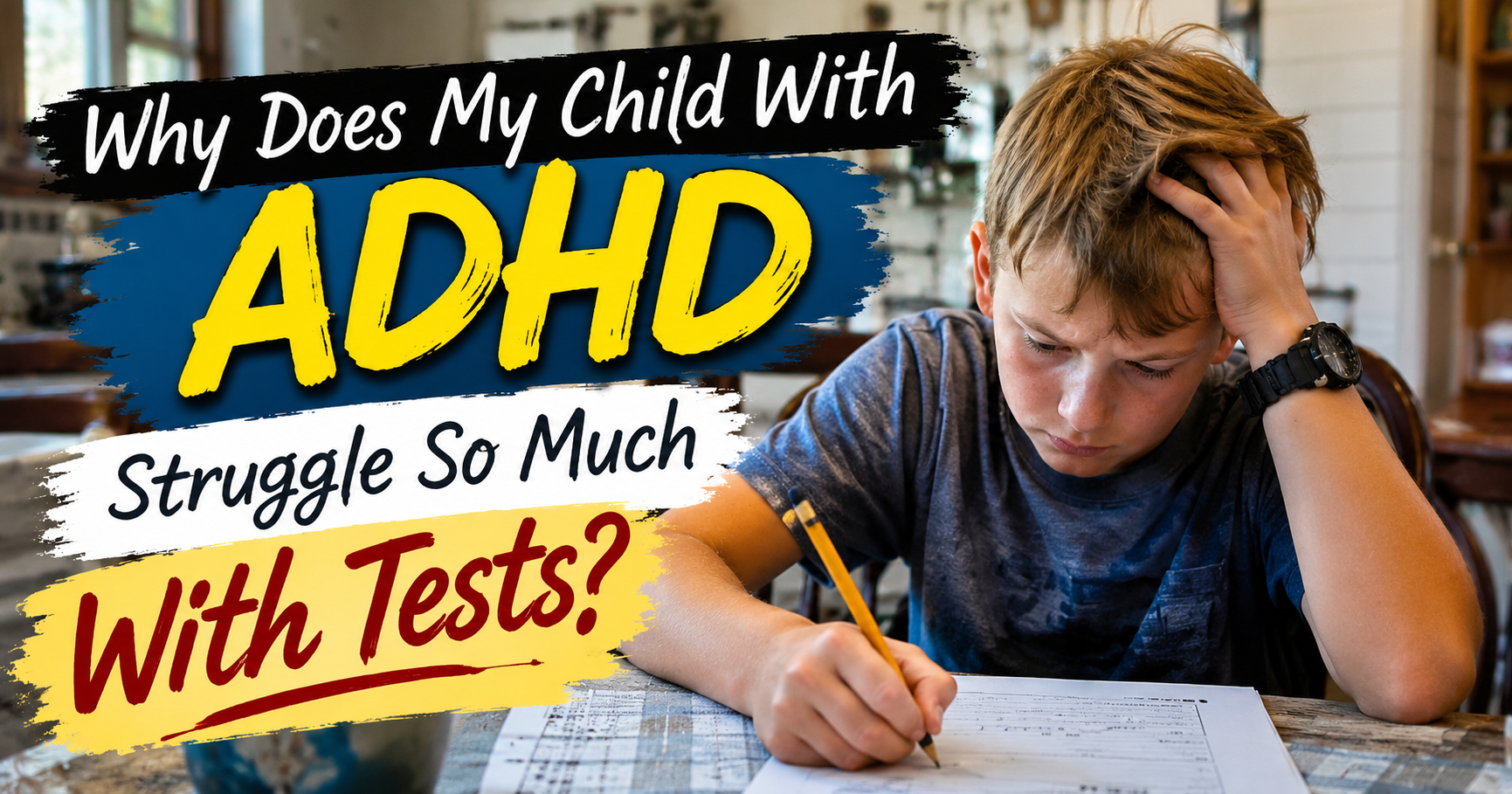
Your child knows the material. You’ve gone over it together, they’ve answered the questions correctly at home, and you’re feeling pretty good about the upcoming test. Then the results come home, and somehow, the score doesn’t match what you thought they knew.
If you’re raising a child with ADHD, situations like this can leave you scratching your head.
My wife and I have a 7-year-old son with ADHD, and school is one of the areas where he struggles significantly. Focusing, remembering instructions, managing frustration, and keeping up with everyday expectations can all be difficult for him.
He’s on medication and sees a mental health doctor, but those challenges haven’t magically disappeared.
I also grew up with ADHD, although mine is much better managed as an adult. My wife has milder ADHD, so we both understand that having trouble concentrating doesn’t necessarily mean someone isn’t trying.
Still, watching your child struggle in school is different from remembering what ADHD felt like when you were a kid.

Children with ADHD can struggle with tests for several reasons, including attention difficulties, working memory challenges, time pressure, and anxiety. Sometimes they’re dealing with more than one of those problems at once.
And before we assume a bad test score means our child isn’t learning, we need to understand what actually happened.
Why Do Children With ADHD Struggle So Much With Tests?
Tests require more than simply knowing the correct answers.
A child has to read or listen to instructions, understand what’s being asked, remember information, stay focused, manage their time, and check their work.
That’s quite a few different skills being used at once.
For children with ADHD, some of those skills can be especially difficult.
Knowing Something and Showing What You Know Are Different Skills
Imagine an elementary school student who understands addition and subtraction.
At home, a parent asks a math question.
The child answers correctly.
But during a classroom test, there are 20 problems on a worksheet, a clock on the wall, classmates moving around, and instructions printed at the top of the page.
The child gets distracted halfway through.
They skip a question without realizing it.
Then they rush through the last few problems because everyone else seems to be finishing.
Suddenly, their test score doesn’t accurately reflect everything they understood.
That’s an illustrative example, but it shows why testing can be complicated for children with attention difficulties.
A child may know the material and still struggle to demonstrate it consistently under test conditions.

ADHD Can Affect Several Parts of Test-Taking
Depending on the child, difficulties may include:
- Sustained attention: Staying focused long enough to finish a worksheet or test.
- Working memory: Holding information in mind while completing several steps.
- Organization: Keeping track of where they are on the page and what needs to be completed.
- Impulse control: Slowing down instead of rushing through questions.
- Time management: Knowing how much time remains and how to use it.
- Emotional regulation: Managing frustration when a question feels difficult.
- Task initiation: Getting started instead of becoming overwhelmed by the entire test.
Not every child with ADHD struggles with all these things.
Some are strong test-takers. Others may have difficulty with written tests but perform well when explaining answers aloud.
That’s why I wouldn’t assume every student with ADHD needs exactly the same support.


Can ADHD Cause Test Anxiety in Children?
ADHD and test anxiety can occur together, but they’re not the same thing.
ADHD affects attention, impulsivity, and executive functioning.
Test anxiety involves worry or distress associated with taking tests or being evaluated.
A child can experience either one without the other.
But when both are present, schoolwork may become particularly challenging.
What Does Test Anxiety Look Like in Elementary School?
Younger children don’t always announce, “I’m experiencing test anxiety.”
They may not even understand why they’re worried.
Instead, parents might notice:
- Complaining about stomachaches before a test.
- Becoming upset while studying.
- Saying they’re going to fail even after practicing.
- Asking repeated questions about what will happen.
- Crying or becoming unusually frustrated over mistakes.
- Freezing when asked to answer questions.
- Having trouble sleeping before an important school day.
These behaviors can have several explanations. They aren’t proof that a child has an anxiety disorder.
However, when they repeatedly happen around tests or school evaluations, they’re worth discussing with the teacher and pediatrician or mental health professional.
ADHD Doesn’t Explain Every School Struggle
This is something I think parents need to remember.
Our son’s ADHD affects several parts of his daily life, and anxiety has also been a concern for our family.
But that doesn’t mean we should automatically attribute every new difficulty to ADHD.
A child who struggles with tests may also have a learning disorder, anxiety, trouble understanding instructions, vision or hearing difficulties, or another concern.
The Child Mind Institute’s explanation of academic anxiety discusses how anxiety, ADHD, and learning difficulties can overlap.
If problems continue despite reasonable support, looking beyond ADHD may be necessary.

Why Does My Child Know the Answers at Home but Get Them Wrong at School?
This is probably one of the most frustrating situations for parents.
You practice something with your child.
They get it right.
Then their test results make it look like they never understood it.
Before getting upset about the grade, I would want to know how the test was given and what kinds of mistakes they made.
The Testing Environment Might Be Part of the Problem
At home, your child may have a parent helping them stay on task.
You might naturally repeat a question, remind them where they were, or explain an instruction.
Those little things can make a difference.
At school, the child may be expected to complete the same task more independently.
That can expose difficulties that weren’t obvious during practice.
For example, a child who can solve math problems when an adult reads the instructions might struggle when they have to read and remember everything themselves.
That doesn’t necessarily mean they don’t understand math.
It might mean the instructions or testing format are creating an additional obstacle.
Look at the Wrong Answers, Not Just the Grade
A score tells you how many questions your child answered correctly.
It doesn’t always tell you why the others were wrong.
Consider these possibilities.
The child left several questions blank.
They may have run out of time, lost focus, struggled to get started, or not known the answers.
The child made careless-looking mistakes.
They might have rushed, misunderstood directions, or had difficulty checking their work.
The child missed every question involving reading.
Reading or language difficulties may be contributing, especially if their math understanding appears stronger when questions are read aloud.
The child struggled mainly with unfamiliar questions.
They may need more instruction or practice applying the material.
The child became upset and stopped working.
Frustration, anxiety, or another emotional difficulty might have interfered.
These patterns can help parents and teachers identify what needs attention.
Simply telling a child to study harder doesn’t address every one of those problems.
How Can Working Memory Affect ADHD Test Scores?
Working memory is something parents hear about frequently when learning about ADHD.
But it can sound more complicated than it really is.
Basically, working memory helps us hold information in mind long enough to use it.
For example, imagine someone tells you a short phone number and you repeat it a few seconds later.
You’re using working memory.
Now imagine your child is solving a math problem that requires several steps.
They need to remember the instructions, keep track of the numbers, and know what to do next.
That also involves working memory.
Why Multi-Step Questions Can Be Difficult
Consider a hypothetical worksheet instruction:
“Read the story, underline the important details, answer the first two questions, and explain your answer in a complete sentence.”
That’s several tasks packed into one direction.
A child with working memory difficulties might remember the first part but forget the others.
Or they may start writing and lose track of what the question originally asked.
That’s not the same thing as refusing to follow directions.
Sometimes the child genuinely loses information while trying to complete the task.
What Can Help?
Teachers may be able to provide instructions in smaller steps or allow children to refer back to written directions.
At home, parents can practice breaking a problem into manageable pieces.
Instead of giving four instructions at once, start with one.
Once the child finishes it, move to the next.
For example:
“First, read the question.”
Then:
“Now tell me what it’s asking you to find.”
Then:
“Let’s choose the first step.”
This helps children practice a process rather than simply guessing at the answer.
For more strategies around focus and attention, we’ve shared our experiences and suggestions in helping a child with ADHD focus at home.
What Can Parents Do to Help Kids With ADHD Prepare for Tests?
I don’t believe the answer is automatically making children study for hours.
For a child who’s already struggling to focus throughout the school day, coming home to another marathon of worksheets can create even more frustration.
The goal should be to make preparation manageable and identify what the child actually needs to practice.
Use Short Study Sessions
Instead of expecting a young child to sit for 45 minutes straight, try shorter periods.
For example, you could practice a few questions, take a brief break, and return to another small group.
A child might work well with five or ten minutes at a time, while another needs a different arrangement.
There’s no universal timer that works for every child with ADHD.
The important thing is paying attention to whether the child is still learning or has become too frustrated to benefit.
Practice the Type of Questions They’ll See
Sometimes children know the subject but aren’t comfortable with the format of the test.
If the teacher uses multiple-choice questions, you could occasionally practice that format.
If the test requires written explanations, practice putting answers into short sentences.
If the questions are read aloud in class, practice listening carefully and identifying what’s being asked.
This is also a good opportunity to ask the teacher what the test will look like.
The goal isn’t to teach children how to memorize answers to a particular test.
It’s helping them become comfortable with the skills they’ll need to demonstrate what they know.
Try Asking Your Child to Explain an Answer
One useful approach is asking children to explain how they reached an answer.
For example:
“How did you figure that out?”
Or:
“What made you choose that answer?”
You don’t need to ask after every problem.
But occasional explanations can help reveal whether your child understands the material or is guessing.
It also gives parents a chance to notice when instructions are confusing.
Don’t Make Every Mistake a Big Deal
When a child already struggles with school, constant correction can become discouraging.
Imagine getting several questions wrong and immediately hearing:
“You knew this yesterday!”
“Why aren’t you paying attention?”
“You’re not trying hard enough.”
Even when parents say those things out of frustration, they may increase pressure.
Instead, focus on understanding the mistake.
“Let’s look at what happened on this one.”
Sometimes the child needs more practice.
Sometimes they misunderstood the question.
And sometimes they simply need a break.

If homework and studying are already a source of conflict in your home, our article about ADHD homework strategies for parents covers that problem in more detail.
What Should a Child With ADHD Do When They Freeze During a Test?
Some children become so overwhelmed that they seem unable to answer questions they normally understand.
For some, anxiety may play a role.
For others, the issue might involve attention, working memory, language difficulties, or the testing environment.
Whatever the cause, telling a frightened child to just relax isn’t particularly useful.
They need a simple plan they can remember.
Practice a Three-Step Test Reset
Here’s one strategy parents can practice at home.
- Stop for a moment. Put the pencil down briefly rather than continuing to panic or guess.
- Look at one question. Focus on the next manageable step instead of the entire worksheet.
- Ask for help with instructions when allowed. If the child doesn’t understand what a question is asking, they can use whatever help or clarification the teacher permits.
Some children may also benefit from a slow breath or a brief movement break.
The idea is to make the next step feel manageable.
This isn’t a guaranteed treatment for test anxiety, but it’s a practical classroom skill children can practice ahead of time.
Make Sure the Teacher Knows What’s Happening
If a child repeatedly freezes during tests, the teacher needs to know.
A child who stops working might appear distracted or unprepared when they’re actually overwhelmed.
Parents can ask whether the teacher has noticed a pattern.
Does it happen during timed tests?
Does the child struggle when questions are read aloud?
Do they perform better in small groups?
Does the problem happen mainly with reading, writing, or math?
Those answers can help determine what kind of support would be most appropriate.

Can Children With ADHD Get Extra Time on Tests?
Yes. Some children with ADHD qualify for school accommodations, including extended time on tests.
But having ADHD doesn’t automatically mean a child needs extra time or receives the same accommodations as every other student with ADHD.
The appropriate support depends on how the disability affects that individual child’s school functioning.
What Test Accommodations Might Help?
Depending on the student’s needs, accommodations may include:
- Extra time to complete tests.
- Testing in a quieter location with fewer distractions.
- Breaking longer tests into smaller sections.
- Short movement or rest breaks.
- Clearer or repeated instructions.
- Alternative ways to demonstrate understanding when appropriate.
- Help with organization or keeping track of completed questions.
The CDC’s guidance on ADHD in the classroom identifies several of these supports, including extra time, breaks, and changes that reduce distractions.
An important point is that extra time isn’t necessarily the answer for every child.
If the real difficulty is understanding the instructions, giving them another 20 minutes may not solve the problem.
We have to match the accommodation to the obstacle.
Does My Child Need an IEP or 504 Plan?
Some students with ADHD receive support through a Section 504 plan.
Others qualify for an Individualized Education Program, or IEP, when they meet eligibility requirements for special education services.
An ADHD diagnosis by itself doesn’t automatically establish which plan, if either, is appropriate.

We’ve already covered the differences in our IEP vs. 504 plan guide for children with ADHD.
If your child consistently struggles with tests, ask the school about an evaluation or a review of their existing supports.
What If the School Says My Child Doesn’t Need Help?
I’d start by asking how that decision was made and what information was considered.
Bring examples of completed schoolwork, test results, teacher observations, and specific concerns.
You can also make a written request for an evaluation if you believe your child may need disability-related services.
Schools have legal obligations under applicable federal disability laws, but the evaluation and eligibility process matters.
A parent shouldn’t have to guess whether their child is entitled to support.
What Should I Ask My Child’s Teacher About Test Problems?
I think this is where parents can make meaningful progress without immediately turning every low grade into a major confrontation.
Teachers spend hours watching how children work.
They may notice patterns that aren’t visible at home.
The key is asking specific questions rather than simply asking why your child failed.
Questions Worth Asking
Here are some useful starting points:
- Does my child seem to understand the material during regular lessons?
- Does he struggle more during tests than during other classroom activities?
- Is he leaving questions blank or answering them incorrectly?
- Does he have difficulty finishing within the allotted time?
- Are distractions interfering with his work?
- Does he become visibly upset, frustrated, or nervous?
- Are there particular subjects where the problem happens most often?
- What supports have already been tried, and did they help?
You don’t have to ask every question in one conversation.
Choose the ones that fit what you’ve noticed.
Compare Classroom Work With Test Results
One thing that may help is comparing several kinds of schoolwork.
For example, if a child regularly performs well during guided math lessons but struggles during independent tests, that’s useful information.
But if they also struggle during daily assignments, the child may need more instruction or a different kind of support.
Neither situation means the child is lazy.
It means we need better information before deciding what will help.

When Is Test Anxiety a Sign That My Child Needs More Help?
Occasional nervousness before a test isn’t unusual.
Many children feel worried when they know their work will be graded.
But persistent anxiety that interferes with learning or everyday life deserves attention.
Signs I’d Take Seriously
Talk with your child’s pediatrician or mental health professional if you notice concerns such as:
- Frequent stomachaches or headaches before school or tests.
- Repeated crying or severe distress about schoolwork.
- Refusing school because of fear about performance.
- Significant sleep problems related to academic worries.
- Ongoing negative statements about themselves or their abilities.
- Anxiety that continues even when there isn’t an upcoming test.
- A noticeable decline in school functioning.
These signs don’t prove a particular diagnosis, but they’re good reasons for further evaluation.
Don’t Assume Medication Will Fix Every School Problem
This is something our family understands.
Our son has been through numerous ADHD medication trials, and finding the right treatment hasn’t been straightforward.
Some medications weren’t effective enough. Others were associated with side effects that concerned us.
Even with professional treatment, his ADHD continues to affect school and daily life.

We share the details of those experiences in our child’s ADHD medication journey.
Medication may help attention and impulse control, but it doesn’t automatically resolve test anxiety, learning difficulties, or every school-related problem.
If a child’s test performance remains poor, their clinician and school team may need to look at additional supports.
Common Questions About ADHD and Test Anxiety
Can ADHD Make a Child Fail Tests Even When They Know the Answers?
Yes. ADHD-related difficulties with attention, working memory, organization, and time management can interfere with test performance.
However, poor test scores can also reflect gaps in understanding, anxiety, or learning difficulties.
Reviewing the child’s actual mistakes can help identify the likely obstacles.
Is Test Anxiety Common in Children With ADHD?
Children with ADHD can also experience anxiety, including worries about school performance.
However, test anxiety isn’t an automatic symptom of ADHD, and not every child with ADHD experiences it.
Persistent distress deserves appropriate evaluation.
Why Does My Child With ADHD Rush Through Tests?
Impulsivity, difficulty maintaining attention, impatience, or wanting to finish quickly may contribute.
Some children also rush because they’re anxious or uncertain about an answer.
Teachers can help identify whether rushing happens consistently and what strategies may improve accuracy.
Why Does My Child Forget Everything During a Test?
A child may struggle to retrieve information under pressure, lose track of multi-step directions, or become distracted.
Anxiety can also interfere with concentration.
If this happens repeatedly, consider discussing working memory, learning concerns, and anxiety with the child’s teacher or clinician.
Can My Child With ADHD Take Tests in a Separate Room?
Some children may qualify for testing in a quieter or separate setting when it’s appropriate for their needs.
This may be included in an IEP or Section 504 plan.
The school team should determine which accommodations address the child’s specific difficulties.
Should I Help My Child Study More if They’re Failing Tests?
More studying isn’t always the answer.
First, determine whether the child understands the material and whether testing conditions are interfering.
Shorter, targeted study sessions may be more helpful than lengthy practice, particularly when attention and frustration are concerns.
Can ADHD Medication Help With Test Scores?
Medication can improve ADHD symptoms for many children, which may help them participate more effectively in school.
However, it doesn’t guarantee higher grades or eliminate anxiety and learning difficulties.
If school performance remains concerning, talk with your child’s treatment team.
What if My Child Says They’re Stupid Because They Failed a Test?
Take the comment seriously without reinforcing the idea that a test score measures their worth.
You might say, “That test was hard, but getting questions wrong doesn’t mean you’re stupid. Let’s find out what made it difficult.”
If negative self-talk becomes frequent, severe, or is accompanied by significant sadness or hopelessness, discuss it with a mental health professional.
How We Look at School Struggles as ADHD Parents
My wife and I want our son to succeed in school, just like any other parents.
But when your child has significant ADHD, success doesn’t always happen by simply telling them to concentrate harder or study longer.
Our son is seven. He’s still learning how to manage a condition that affects his attention, memory, and emotions, even while receiving treatment.
I know from growing up with ADHD that struggling to focus doesn’t mean a child doesn’t care.
And as a parent, I also understand how discouraging it can be when you know your child is capable of more than their schoolwork seems to show.
That’s why I think test scores should start conversations, not simply end them.
If a child understands something but struggles to demonstrate it, we need to understand why.
If they genuinely don’t understand the material, they need instruction and support.
And if anxiety or another difficulty is getting in the way, they deserve help with that, too.
A low test score isn’t the whole story of what a child knows, how hard they’re trying, or what they’ll eventually be able to accomplish.