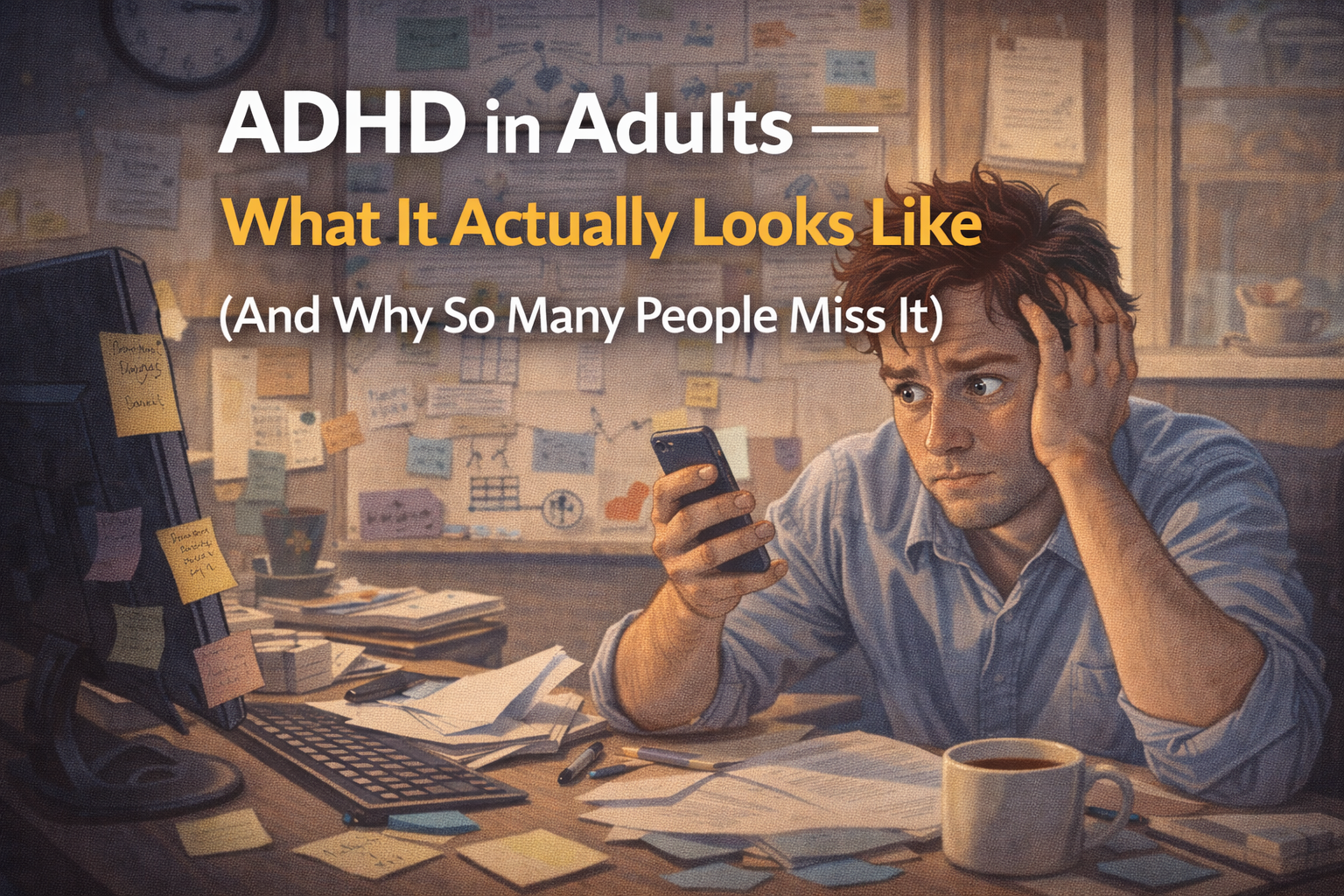
You’ve spent your whole adult life assuming you were just bad at being a person.
Bad at keeping a tidy house. Bad at replying to emails. Bad at finishing projects. Bad at being on time. Bad at remembering things. Bad at not snapping when you’re overwhelmed.
And then someone — a therapist, a doctor, a TikTok video, your kid’s diagnosis paperwork — puts the words “ADHD” in front of you, and something shifts.
Oh. That’s what this is.
If you’re an adult reading this and wondering whether ADHD explains a lot of your life, you’re not alone. More than half of adults diagnosed with ADHD weren’t diagnosed until age 18 or older — and many don’t find out until their 30s, 40s, or beyond. A 2024 national survey found that 25% of American adults now suspect they have undiagnosed ADHD.
This is what ADHD actually looks like in adults — not the hyperactive kid stereotype, but the real, daily experience of living with a brain that works differently from most of the world around you.


Adult ADHD Looks Different Than You Think
The image most people have of ADHD is a young boy bouncing off the walls who can’t sit still in class. That’s one presentation. But adult ADHD — especially in people who weren’t diagnosed as kids — often looks nothing like that.
Here’s what it actually looks like in daily life:
- 📧 An inbox with 4,000 unread emails — not because you don’t care, but because you genuinely can’t figure out how to start tackling it
- ⏰ Always running late — even when you tried to leave early, something derailed you and you don’t fully understand what
- 🔁 Starting projects with huge energy, abandoning them — the dopamine rush of new things fades fast and finishing becomes almost impossible
- 💸 Impulsive spending — buying things you don’t need because the decision feels urgent and good in the moment
- 🗂️ Losing things constantly — keys, wallet, phone, your train of thought mid-sentence
- 😤 Emotional reactions that feel too big — getting flooded with frustration, irritability, or overwhelm over things other people seem to brush off
- 🌙 Can’t wind down at night — brain races the moment you stop being busy
- 💼 Underperforming at work relative to your intelligence — you know you’re capable of more, but something always gets in the way
- 😔 Years of being labeled lazy, scattered, or “not living up to potential” — by teachers, bosses, family, and yourself
None of that looks like a kid jumping off furniture. But all of it is ADHD.


Why So Many Adults Are Just Finding Out Now
ADHD was treated for most of the 20th century as a childhood condition that kids grew out of. We now know that’s wrong — research shows ADHD persists into adulthood in the majority of cases. But decades of that assumption meant adults slipped through undiagnosed.
Several groups were especially likely to be missed:
👩 Women with ADHD
Girls with ADHD tend to present with primarily inattentive symptoms rather than hyperactive-impulsive ones — so they didn’t get flagged as problems in the classroom. They learned to mask, compensate, and internalize. Many were diagnosed with anxiety or depression — which often are real, but are secondary to the unidentified ADHD underneath. Many women don’t seek evaluation until their own child is diagnosed and they recognize themselves in the description.
🎓 High achievers
Intelligence and determination can mask ADHD symptoms for years. If you were smart enough to compensate through high school and college, the wheels often come off when adult responsibilities stack up — career, relationships, finances, household management — and there’s no longer a structured external system holding everything together for you.
🤫 Kids who learned to hide it
Some ADHD kids become expert maskers — developing elaborate workarounds to appear more functional than they feel. By adulthood, the mask is so well-worn they don’t recognize it as a mask anymore. They just know they’re exhausted all the time from the effort of appearing “normal.”
What’s Actually Happening in the ADHD Brain
ADHD isn’t a focus problem. It’s a self-regulation problem — specifically, a disorder of executive function.
Executive functions are the brain’s management system: the cognitive processes that handle planning, prioritizing, starting tasks, managing time, regulating emotions, and working memory. Research consistently shows these are significantly impaired in adults with ADHD — not because of laziness or lack of intelligence, but because of measurable differences in how the prefrontal cortex functions and communicates with the rest of the brain.
The result is a brain that:
- 🧩 Struggles to start tasks — even ones you genuinely want to do
- ⏳ Has a distorted sense of time — there is “now” and “not now,” with very little in between
- 🔋 Needs higher stimulation to engage — ordinary tasks provide insufficient dopamine to sustain effort
- 🎯 Can hyperfocus intensely on things it finds interesting — and go completely blank on things it doesn’t
- 😡 Regulates emotions less efficiently — feelings hit harder and take longer to settle
- 🔄 Loses information from working memory quickly — out of sight genuinely is out of mind
Studies show that 58% of employees with ADHD report high burnout levels — largely because they’re spending enormous energy trying to function in systems designed for a different kind of brain. That’s not a character problem. That’s a mismatch problem.
How ADHD Shows Up in Specific Areas of Adult Life
💼 Work
- Procrastination that isn’t laziness — task initiation is genuinely impaired
- Difficulty with long projects that have no immediate deadline pressure
- Making careless errors despite caring about the work
- Talking too much in meetings, interrupting, saying things you wish you hadn’t
- Hyperfocusing on interesting work while urgent-but-boring tasks pile up
- Getting overwhelmed by email and defaulting to avoidance
- Struggling with performance reviews that require self-reflection and goal-setting
Adults with ADHD earn up to 33% less globally than peers without ADHD — a gap that exceeds those seen with gender or race. That’s not about ability. It’s about a workplace world built around consistent, steady, organized execution — the exact things ADHD makes hard.
🏠 Home and Household
- Perpetual clutter despite genuine effort to stay organized
- Starting cleaning and ending up reorganizing one drawer for two hours while the rest stays messy
- Forgetting bills, appointments, things that need to be done
- Feeling like the household “management” system never works no matter what you try
- Buying groceries you already had because you forgot to check
The ADHD Grocery List PDF is a small but genuinely useful tool here — a structured list format designed for ADHD brains that stops the “I’ll remember it” trap dead.
💑 Relationships
- Partners feeling ignored, unheard, or like they’re carrying the mental load alone
- Forgetting important dates, conversations, things you promised
- Emotional dysregulation straining closeness — reactions that feel disproportionate
- Rejection sensitive dysphoria — taking criticism far harder than seems “rational”
- The frustration of knowing what you should do but not being able to make yourself do it
💰 Money
- Impulsive purchases that feel reasonable in the moment and confusing in retrospect
- Forgetting to pay bills until they’re overdue
- Difficulty sustaining the boring, repetitive work of budgeting
- Financial anxiety from years of unstructured money management

The ADHD Exhaustion No One Talks About
Here’s the thing about functioning with undiagnosed or unsupported ADHD as an adult: it is exhausting in a way that’s nearly impossible to explain.
You’re not just doing tasks. You’re doing tasks while simultaneously managing a brain that resists starting, loses its place, needs constant redirection, and then floods you with shame when things don’t get done. That’s a whole second job running in the background every minute of every day.
Over 50% of adults with ADHD have at least one co-occurring condition — most commonly anxiety and depression. This isn’t coincidence. Years of struggling in systems not built for your brain, of being called lazy or irresponsible, of knowing you’re capable but consistently falling short — it takes a psychological toll that shows up as something that looks a lot like anxiety and depression, because it often is.
The problem is when those conditions get treated without the underlying ADHD being identified. You address the symptom while leaving the source untouched.
What an Adult ADHD Diagnosis Actually Changes
Getting diagnosed as an adult doesn’t fix anything automatically. But it changes something important: the frame.
You stop explaining your struggles as personal failure and start understanding them as a neurological reality you can work with. That’s not an excuse — it’s a foundation for actually building effective strategies instead of white-knuckling through the same ones that haven’t worked for 30 years.
What tends to help adults with ADHD:
🛠️ External Structure (Since the Brain Won’t Create It Internally)
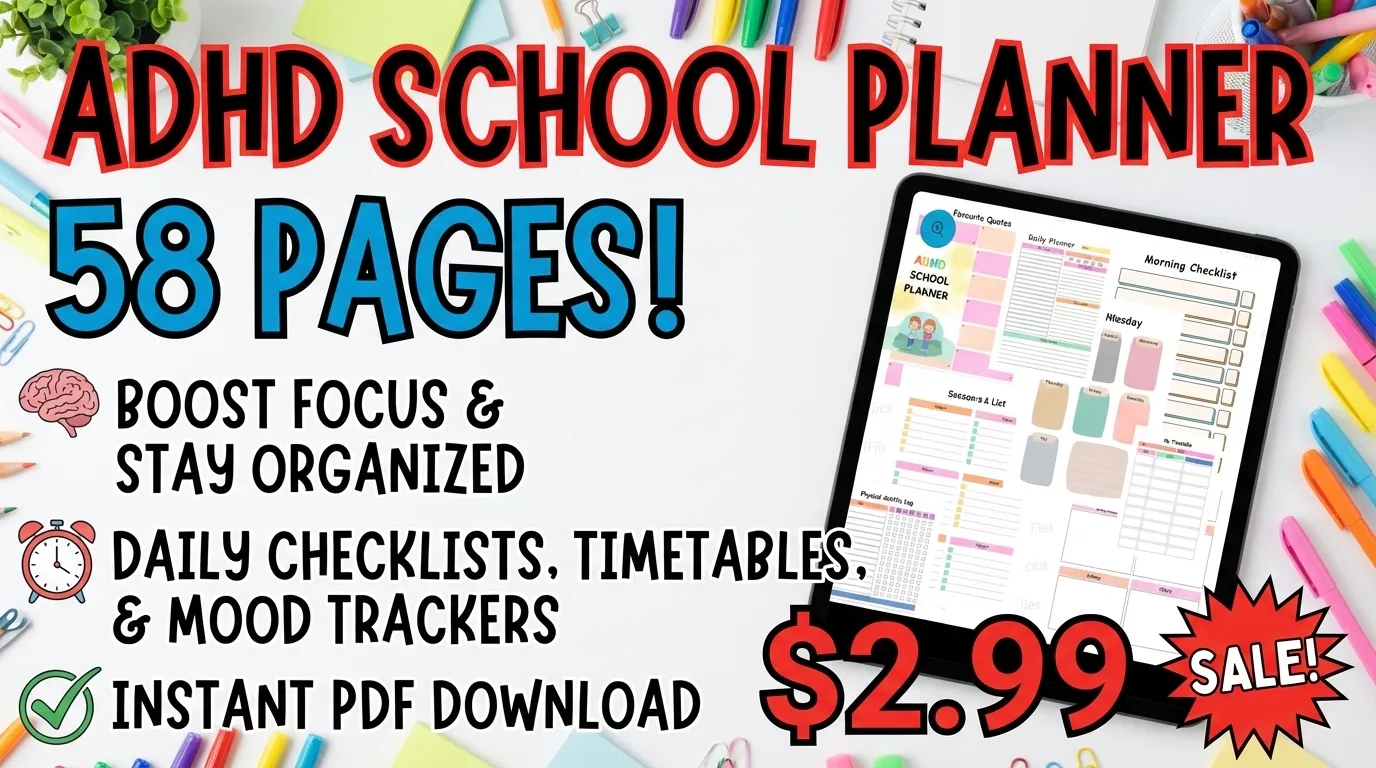
- Planners specifically designed for ADHD brains — the SUNEE ADHD Daily Planner is one of the most popular adult options, with a 3-month undated format built around time blocking and priority-setting rather than generic to-do lists
- Time blocking on a calendar — treating every task like an appointment with a start and end time
- Visual timers for work sessions — the Pomodoro Visual Timer makes time concrete and containable
- Body doubling — working alongside another person (even virtually) dramatically improves task initiation for many adults with ADHD
🧠 Working With Your Brain’s Dopamine System
- Pair boring tasks with something engaging — a podcast, music, a specific drink you only have during that task
- Use deadlines deliberately — if a task has no deadline, create an artificial one with stakes
- Break projects into the smallest possible first step — not “write the report” but “open the document”
- Reward yourself immediately after completing something hard — the ADHD brain responds to now, not later
📱 Reducing Friction Everywhere
- Put important things in the exact same place every single time — the ADHD brain needs physical cues, not memory
- Automate whatever can be automated — bills, subscriptions, appointments
- Use voice memos instead of mental notes — “I’ll remember it” is a lie your brain tells you
- Keep your environment lower-stimulation during focus work — noise-canceling headphones change everything for many ADHD adults
💊 Medical and Therapeutic Support
Medication — typically stimulants or non-stimulants — works well for many adults with ADHD. Stimulants for ADHD are among the most effective medications in all of psychiatry. That’s not a minor claim — it comes from direct research comparison. If you haven’t had a conversation with a doctor about whether medication might help, it’s worth having.
Cognitive Behavioral Therapy (CBT) adapted for ADHD is also well-evidenced — it builds the skills (planning, organizing, emotional regulation) that ADHD makes harder to develop naturally.
A Note If You’re a Parent Who Just Recognized Yourself
ADHD is highly genetic. If your child has it, there’s a meaningful chance you do too — or that another parent in your family does. Many adults find their own diagnosis path through their child’s.
That recognition can be complicated — grief for the years you didn’t have the right framework, relief that there’s finally an explanation, guilt that your child may have inherited this from you, and maybe some anger that no one caught it sooner.
All of that is valid. And importantly: understanding your own ADHD makes you a better parent to your ADHD child. You know what it feels like from the inside. That empathy is genuinely powerful.
If sleep is one of your struggles too, the science and strategies in our post on ADHD and sleep apply to adults just as much as kids. And if you’re navigating emotional regulation, everything in our article on ADHD emotional dysregulation maps onto adult experience as much as childhood.
Frequently Asked Questions
Can you develop ADHD as an adult?
The current clinical consensus is that ADHD is a neurodevelopmental condition — symptoms must have been present since childhood, even if they weren’t recognized. What often happens is that adults were missed in childhood, or compensated well enough that symptoms weren’t obvious until adult demands exceeded their coping capacity. “Late onset” usually means late diagnosis, not late development.
How do I know if I have ADHD or just anxiety/depression?
This is genuinely hard to tease apart, and often requires a proper evaluation because the conditions overlap significantly. ADHD and anxiety/depression also frequently co-occur. The key question is whether the anxiety or depression seems to have an underlying cause rooted in executive function struggles — disorganization, chronic lateness, difficulty finishing things, feeling overwhelmed by daily life — rather than other life circumstances. A psychiatrist or psychologist can help sort this out properly.
Is it worth getting diagnosed as an adult?
Most people who get a late diagnosis say yes — emphatically. Understanding the actual source of your struggles shifts the approach from “try harder at the same things” to “find strategies that actually work for this brain.” Medication, if appropriate, can be effective. And the psychological relief of having an explanation — not an excuse, an explanation — matters more than most people expect before they have it.
What’s the first step if I think I have ADHD?
Start with your primary care doctor. Describe what you’re experiencing functionally — not “I think I have ADHD” but “I’ve struggled my whole life with starting tasks, staying organized, managing time, and I’m wondering if there’s something neurological going on.” They can screen you and refer you to a psychiatrist or psychologist for a full evaluation if warranted.
You Were Never Just Bad at Life
That’s the hardest thing to absorb after a late ADHD diagnosis — or even after reading an article like this and recognizing yourself in it.
You weren’t lazy. You weren’t irresponsible. You weren’t a disappointment. You were running a different operating system in a world built for another one, without any manual, and doing the best you could with what you understood about yourself.
The understanding changes things. Not instantly. Not completely. But genuinely.
Start there.
About the Author
Lisa Fenn is a behavioral therapist and mom who was diagnosed with ADHD at 38 — two years after her youngest son was. She writes from both professional experience and lived reality, and has a particular interest in the gap between what ADHD looks like in textbooks and what it looks like in actual daily life. She lives in Colorado and is working on finishing approximately four different half-written books.
As an Amazon Associate, we earn from qualifying purchases through some links in our articles. Read our full Affiliate Disclosure here .