
ADHD kids aren’t ignoring chores on purpose — their brains make it genuinely hard. Here’s why it happens and the exact systems that actually get chores done without the meltdowns.

You ask your kid to clean their room. Thirty minutes later you walk in and they’re sitting in the middle of the floor holding a Lego they found under the bed, completely lost in thought.
The room? Still a disaster.
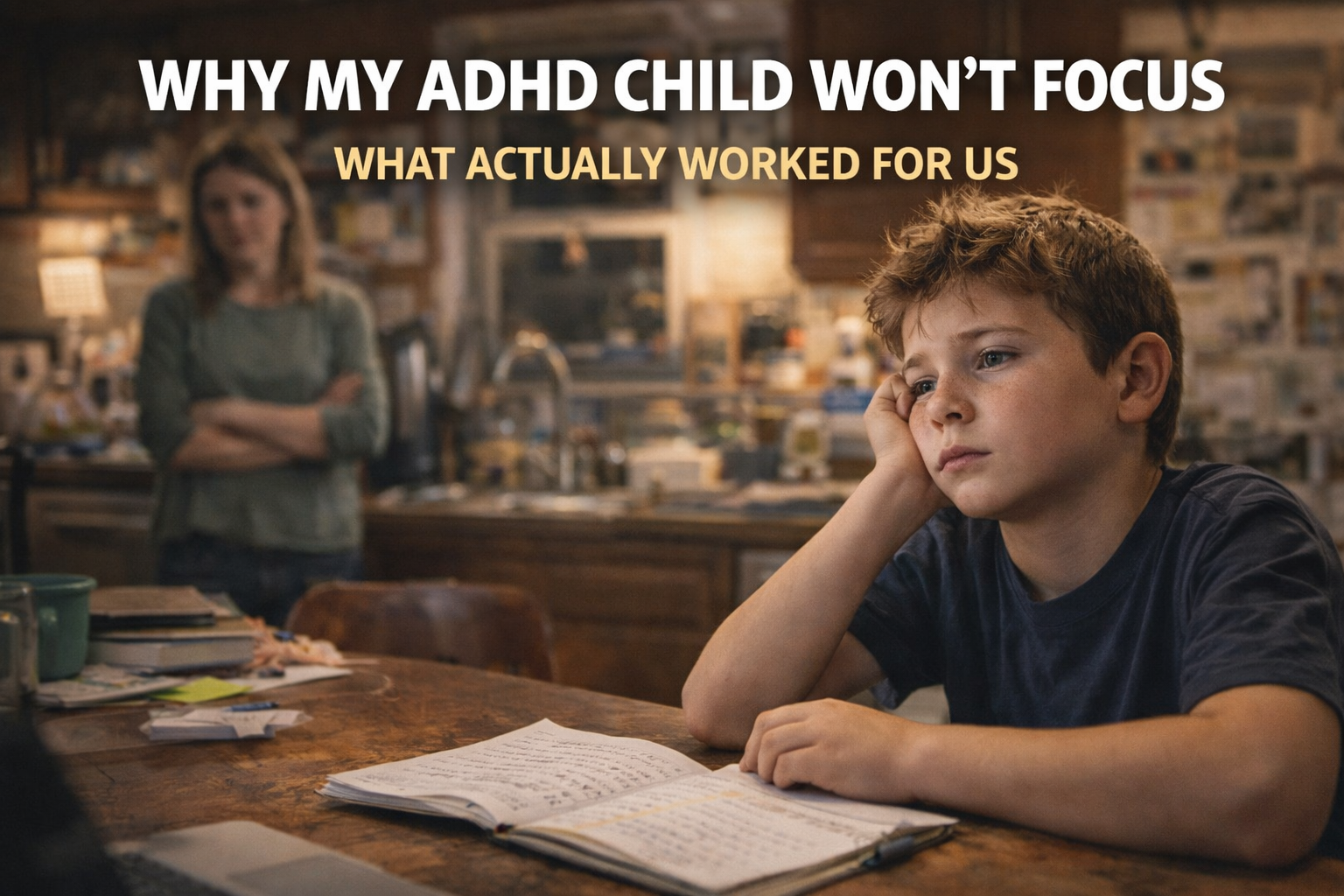
Sound familiar? If you’re raising a child with ADHD, this scene probably plays out in your house on a weekly basis — and it has nothing to do with laziness, defiance, or not caring. It has everything to do with how the ADHD brain is wired.
Once you understand why chores are genuinely hard for ADHD kids, the strategies start to make a lot more sense. So let’s start there.


Why ADHD Kids Struggle with Chores (It’s Not What You Think)
The short answer: chores are an executive function nightmare.
Executive function is the brain’s management system — the part that handles planning, sequencing steps, managing time, remembering what you’re supposed to be doing, and transitioning from one task to another. Research shows that kids with ADHD run about 2–3 years behind their peers in executive function development. So a 10-year-old with ADHD may have the task-management skills of a 7-year-old.
That’s not a character flaw. That’s neurology.
Here’s what’s actually happening when your child can’t get chores done:
- 🧠 They can’t break the task into steps. “Clean your room” sounds simple to you. To their brain, it’s an undefined wall of overwhelm with no clear starting point.
- ⏱️ They have no sense of time passing. They genuinely don’t feel 20 minutes go by. If it feels like they’ve been working forever and nothing is done — they’re not exaggerating.
- 🔀 Transitions are hard. Moving from something they enjoy (games, video) to something they don’t (chores) requires executive effort their brain resists.
- 🔁 Working memory is limited. They start cleaning, get distracted by something they find, and completely forget what they were doing. Not on purpose.
- 📋 Multi-step tasks fall apart. A chore that involves picking up, sorting, wiping, and putting away is four separate tasks. That’s a lot to hold in a working memory that’s already stretched thin.
Research confirms this is widespread — more than 90% of parents of kids with ADHD report that their child’s symptoms directly affect their ability to complete household chores. You’re not alone in this.



Why Chores Actually Matter More for ADHD Kids
Before we get into what works, it’s worth knowing that giving up on chores isn’t the answer — even when it feels easier.
Studies show that kids who regularly complete household chores develop stronger working memory and better self-regulation over time. These are the exact executive function skills that ADHD kids need most. Done the right way, chores aren’t punishment — they’re actually practice for the brain.
Chores also build something bigger: a sense of competence. An ADHD child who hears mostly “why didn’t you finish?” and “I told you twice already” starts to see themselves as someone who can’t follow through. Small, consistent chore wins flip that script.
The #1 Mistake Parents Make with ADHD Chores
Giving vague instructions and expecting independent follow-through.
“Clean your room.” “Tidy up.” “Help with the kitchen.”
These instructions are perfectly reasonable for a neurotypical kid. For an ADHD brain, they’re basically unsolvable. There’s no clear start, no defined finish line, no steps to follow, and no built-in feedback telling them they’re on track.
The fix: Stop giving tasks. Start giving systems. Every strategy below is built on that idea.


Age-Appropriate Chores for Kids with ADHD
Match the chore to where your child’s executive function actually is — not their age. Remember the 2–3 year lag. A 9-year-old might be ready for chores that suit a typical 6–7-year-old.
Ages 4–6
- Put dirty clothes in the hamper
- Put shoes in the same spot every time
- Feed a pet (with a visual reminder)
- Put their plate in the sink after meals
- Wipe the table with a damp cloth
Ages 7–10
- Make their bed (set a low bar — “covers pulled up” counts)
- Sort laundry into lights and darks
- Empty the dishwasher (with labeled cabinets)
- Take out one trash bin
- Set the table for dinner
- Sweep a small area
Ages 11–14
- Vacuum one room
- Do their own laundry (one load, start to finish)
- Wash dishes or load the dishwasher
- Clean the bathroom sink and mirror
- Mow the lawn (with clear start and stop boundaries)
Key principle: One chore mastered beats five chores half-done. Start with one daily task. Build from there.


What Actually Works: 8 Strategies for ADHD Chores
1. Break Every Chore into Numbered Steps
Don’t say “clean your room.” Post a list that says:
- Pick up clothes off the floor
- Put dirty clothes in the hamper
- Put clean clothes on the bed
- Clear your desk
- Make your bed
Each step is its own mini-task with a visible finish line. This is exactly what the ADHD Cleaning Checklist PDF is designed for — a ready-made visual breakdown so you don’t have to create a new list every time.
2. Use a Visual Timer
ADHD kids don’t feel time passing the way you do. A visual timer they can see counting down makes time concrete. “You have 15 minutes on the timer to clear the living room” is completely different from “go clean up for a little while.”
The Pomodoro Magnetic Visual Timer is one of the most parent-recommended tools for this — it flips, shows visual countdown, and has a quiet mode so it’s not distracting. Game changer for timed chore sessions.
3. Work Side by Side, at Least at First
Many ADHD kids need a co-regulator — someone else’s presence and energy to anchor them to the task. This doesn’t mean doing it for them. It means working nearby, checking in, keeping the momentum going with brief verbal prompts.
“You’re doing great — what’s next on your list?”
Over time, fade your presence gradually as the routine becomes automatic.
4. Never Say “Go Clean Your Room Before You Can Play”
Long time horizons don’t work for ADHD brains. Research from ADDitude confirms that rewards set too far in the future feel completely abstract and unmotivating. “Do your chores this week and we’ll go somewhere fun on Saturday” is basically invisible to them.
Instead, use immediate micro-rewards:
- “Finish this one step and you can have 5 minutes of free time.”
- “When the dishwasher is empty, we’ll start the movie.”
- A sticker or token the moment a chore is done — no delay.
5. Label Everything
Where does this go? For an ADHD brain, that question can genuinely stop all motion. Labeled bins, labeled shelves, labeled drawers remove that friction completely. They don’t have to figure out where things belong — the label tells them.
This is especially powerful for cleaning up shared spaces like the living room, playroom, or bathroom.
6. Same Time, Same Day, Every Week
Routine reduces resistance. When a chore happens at the same time every day or every week, it stops being a negotiation and starts being just what happens. Saturday morning after breakfast is chore time — not a question, not a debate, just what comes next.
Predictability is one of the most powerful tools in the ADHD parenting toolkit. It offloads the “when do I have to do it?” mental load entirely.
7. Keep It Short
A 10-minute daily chore beats a 90-minute weekly cleaning marathon every time for ADHD kids. Short, frequent, predictable chunks of work are far more manageable than infrequent long sessions that feel infinite and overwhelming.
“10-minute tidy” at the same time every evening can completely transform the baseline mess level in your house — and it’s actually doable for your kid.
8. Separate the Chore from the Mood
Don’t wait for them to be in the right mood. Don’t argue about attitude. Calmly redirect to the task. “I know you don’t want to. The chore still needs to happen. What do you need to get started?”
Getting into a power struggle about whether they want to do the chore is a trap that almost always escalates. Keep your energy neutral and practical.
Reward Systems That Actually Work for ADHD
Standard sticker charts often fail ADHD kids because the reward is too delayed and the steps are too vague. Here’s what works better:
- ✅ Token economy: Earn a token immediately for each completed chore. Tokens cash in for small, frequent rewards — screen time, a treat, choosing dinner. The key is immediate and specific.
- ✅ First-then boards: “First dishes, then you pick the show.” Visual, simple, no room for debate.
- ✅ Gamify it: Beat the timer, race a sibling, try to finish before a song ends. Turning it into a game injects the novelty and dopamine that ADHD brains need.
- ❌ Skip: Reward charts with too many steps, too many chores, or rewards that are days away. These fall apart fast.

Tools That Make Chores Easier
A few things we use and recommend:
- ADHD Cleaning Checklist PDF — printable, broken into steps, designed specifically for ADHD brains. Print it, laminate it, hang it where the chore happens.
- Pomodoro Magnetic Visual Timer — visual countdown for timed chore sessions. Works beautifully with the “10-minute tidy” method.
- ADHD Skill Cards for Kids — 52 guided cards covering emotional regulation, focus, and behavior. Helpful for the moments when chore resistance turns into meltdown territory.

When Chores Turn Into Meltdowns
Sometimes you do everything right and it still goes sideways. Your kid refuses, shuts down, or escalates. Here’s what to do — and not do:
Do:
- Stay calm. Your regulated nervous system is the most powerful tool in the room.
- Give them a break if dysregulation is high — 10 minutes to decompress, then return to the task.
- Reduce the task. “Okay, just pick up 5 things off the floor. That’s it for now.”
- Acknowledge the feeling without excusing the behavior. “I know this feels annoying. The dishes still need doing.”
Don’t:
- Threaten consequences in the heat of the moment. Escalation leads to more escalation.
- Do the chore for them to end the conflict — this teaches avoidance works.
- Make it personal. “Why can’t you just listen?” only adds shame to an already overwhelmed brain.
For more on navigating the emotional side of ADHD parenting, our post on how to help a child with ADHD focus at home without losing your mind is a good place to go next. And if bedtime is as hard as chores in your house, we’ve covered how we finally fixed our ADHD bedtime battles too.
The Chore That Changed Everything for Us
We spent two years fighting about chores before we figured out we were doing it wrong.
We were giving too many at once. Too vague. With rewards that were too far away. And we were expecting our son to just know what “clean the kitchen” meant.
The shift happened when we went down to one chore — just one. Empty the dishwasher, every morning after breakfast, same time every day. We made a laminated card showing exactly where each item goes. We set a timer. We gave him a token the moment it was done.
Two months later, it was automatic. Then we added a second chore.
It sounds painfully slow. But slow and working is infinitely better than fast and failing. Your kid needs wins. Build from there.
About the Author
James Merritt is a dad of three and a former elementary school teacher who spent years working with kids with ADHD before realizing his own son had it too. He writes about practical systems, routines, and the stuff that actually holds up in real family life — not just in theory. He lives in Tennessee and coaches youth baseball on weekends.
As an Amazon Associate, we earn from qualifying purchases through some links in our articles. Read our full Affiliate Disclosure here .